Okay, so a few months ago I started fiddling around with discussing the Two Kingdoms concept (for lack of better term off the top of my head), the Armor of God, and Heresies.
Yeah, that's being shelved for a while.
The initial "why" is because my family and I are moving before the end of the month. We are (finally) moving to Fort Wayne, Indiana, and I am enrolled at Concordia Theological Seminary.
(It's official. Yay!)
The summer Greek class at Seminary starts in June, so I'll be quite busy for the next few years (and after, to be honest). That probably means less content here, at least until I figure out the balance of work. That also means working on how I teach and preach. But I've already invested a lot in the "knight" and "soldier" metaphors as teaching tools, so I won't be tossing everything away, but some readjustments are likely needed.
What this all means is I'll be dialing back on the "original" theological content, except for weekly devotions and thoughts on the readings and possibly posting essays and papers from class. I intend on weekly "reports from the frontline" as I progress through seminary, as well.
Once I get a better handle on stuff, I'll be back with "big stuff," like the Two Kingdoms, Three Estates, and Soldiers. They'll be teasers, prototypes, and table scraps along the way, especially since I'm trying to figure out how to set up a podcast on Church history, especially early Church history. More on that when I get things worked through and get more of the history under my belt.
*Other randomness I post here, like aircraft and Star Wars, may or may not be effected by this move.
Showing posts with label Two Kingdoms. Show all posts
Showing posts with label Two Kingdoms. Show all posts
Tuesday, May 8, 2018

Friday, September 29, 2017
Render Unto Gary Cooper What Is Alvin York's (or) Dual Loyalties Don't Necessarily Mutually Exclude [part V]
So, after four days of this, you are probably asking "why does the title say Gary Cooper and Alvin York?" "I know Cooper was an actor, but who's York?" "What does a 1930s Hollywood actor have to do with this?"
All good questions. But first, let me ask you, do you know who Alvin York was?

If you get the chance, watch the 1941 movie "Sergeant York." It does a good job of depicting the man's life. It should, York was the guy who picked Gary Cooper (his favorite actor) to play him. And, yes, he really did capture 132 Germans after having a duel with 30 machine guns. By himself. Captain America ain't got nothin' on York.
And while the historian in my could go on about a story like this, that's not the point this time. Rather, I'm going to talk about how this former hellion turned pacifist was granted a Medal of Honor for killing 28 enemy and capturing 132.
Now, it has been a number of years since I watched the movie, but a few weeks ago it was on and I caught about 30 minutes of it during my lunch break. I saw from his recruitment to the battle he became famous for. His struggle, and answer, got me thinking about vocation.
What is vocation?
Simply put, a "vocation" is a task or duty for someone to complete. Currently, my primary vocations include "husband," "father," "child," "sibling," and "employee." Soon "student" will be added to the list, and after that "pastor."
Some of these duties overlap, such as husband and father. Rarely are they mutually exclusive. And a vocation does not have to be "religious." I heard Luther once quoted as saying a mother changing diapers (which is part of the vocation of parent) is more "spiritual" than a monk saying vespers.
So, back to York. He had chosen to be a pacifist, which is not required of the vocation of Christian, but his rational is completely understandable (since he converted, gave up alcohol, and went pacifist after a friend died in a duel). However, the government chose him to become a soldier. Within the vocation of soldier, being violent in controlled instances is the core task.
The movie depicts him in training, doing admirably. The city kids who were recruited made fun of his accent (Tennessee) and simplistic yet direct thinking. The instructors did too. Until they handed him a rifle. Most recruits had no idea how to shoot a gun. York grew up with a muzzleloader he used to hunt with. Hitting a bed sheet fifty yards away was too easy for him. His skill with a gun was part of why he was promoted to corporal.
That's when he became more vocal about his desire not to kill. His sergeant, his commanding officer, and the officer in charge of the entire unit, all spoke with him, and did so rationally, not just "you'll follow orders!" you would have expected.
Where it comes to a head is when he's given some leave before, likely, shipping out. He is encouraged to go home and consider what to do. While discussing if it is right for a Christian to fight in a war, he and the officers trade quotes from Scripture, and correctly, not just proof-texting. The CO finally hands him a book on American history, specifically on the Founding Fathers, encouraging York to read it and consider. He does.
Finally, back home, sitting alone with this history book in one hand and the Bible in the other, Alvin York is at a loss. What is he to do? The Christian side of him says "don't fight." The American side of him says "defend your nation."
Which is correct?
Opening his Bible, he turns to Matthew chapter 22. Verse 21 provided the answer.
An antithesis to this, though still just as correct an understanding of the proper distinction between being a Christian and being a soldier, is Desmond Doss. His story is told in the movie "Hacksaw Ridge," which tells the story of his service as an unarmed medic. He elected to enter a combat zone unarmed, in a war against an enemy who would see no issue of killing a medic. But his version of Christianity forbid him from carrying a weapon. So he served during the invasion of Okinawa, some of the bloodiest fighting in all of human history. And at no point did he draw blood. Like York, he earned the Medal of Honor, and is the only unarmed conscientious objector to earn said medal.
So who is more correct in understanding vocation and the proper distinction of the Two Kingdoms, Alvin York or Desmond Doss?
Both.
Give to caesar what is caesar's, and to God what is God's. We are to serve within our vocations both the State and the Church. For the one in a position of authority in the State, executing their powers is appropriate and even Godly. Yes, even killing an enemy soldier.
Now, this does not excuse war, nor do I mean to make the implication that war is God's desire. Far from it. But this is a sinful world, and conflict occurs. And, like York discovered, being a soldier does not keep one from being a faithful Christian.
See, in the end this Two Kingdoms doctrine is easy, but intricate. The teaching is simple, but there are many moving parts, and quickly we find ourselves in a theoretical discussion. Not that this is a bad thing, but we cannot dwell here. That was the mistake of the monastic movement. Vocation and the Two Kingdoms and the Estates are, in a way, a call to "put your money where your mouth is" and see your life as Christian and [fill-in-the-blank] overlap.
And if any of this discourages you, just remember the one who never struggled with this. His vocation of King and Servant were concurrent, as were His duties as both God and Man. As a humble servant He was nailed to the Cross. As the creator of the universe He rose from the dead. Christ's two natures are not mutually exclusive, but are both active now. If He is any less of one vocation or the other He is no longer the Christ.
Just like how the Triune God is simultaneously all Three Persons; distinct and authoritative in their duties, but united in their action. You cannot have one without the other two.
Funny how all discussions of doctrine run back to Christology and the Trinity. Almost like they actually matter. Like that's all where supposed to focus on anyway...
Now, on to a new topic... once I find one. Well... that's not true. There's plenty, just not sure if the blog, as it is right now, it the most logical format. I'll play with them and see what happens. Until them....
All good questions. But first, let me ask you, do you know who Alvin York was?

(Big ears were so in style in 1918. Epic 'staches a suggested option.)
If you get the chance, watch the 1941 movie "Sergeant York." It does a good job of depicting the man's life. It should, York was the guy who picked Gary Cooper (his favorite actor) to play him. And, yes, he really did capture 132 Germans after having a duel with 30 machine guns. By himself. Captain America ain't got nothin' on York.
And while the historian in my could go on about a story like this, that's not the point this time. Rather, I'm going to talk about how this former hellion turned pacifist was granted a Medal of Honor for killing 28 enemy and capturing 132.
Now, it has been a number of years since I watched the movie, but a few weeks ago it was on and I caught about 30 minutes of it during my lunch break. I saw from his recruitment to the battle he became famous for. His struggle, and answer, got me thinking about vocation.
What is vocation?
Simply put, a "vocation" is a task or duty for someone to complete. Currently, my primary vocations include "husband," "father," "child," "sibling," and "employee." Soon "student" will be added to the list, and after that "pastor."
Some of these duties overlap, such as husband and father. Rarely are they mutually exclusive. And a vocation does not have to be "religious." I heard Luther once quoted as saying a mother changing diapers (which is part of the vocation of parent) is more "spiritual" than a monk saying vespers.
So, back to York. He had chosen to be a pacifist, which is not required of the vocation of Christian, but his rational is completely understandable (since he converted, gave up alcohol, and went pacifist after a friend died in a duel). However, the government chose him to become a soldier. Within the vocation of soldier, being violent in controlled instances is the core task.
The movie depicts him in training, doing admirably. The city kids who were recruited made fun of his accent (Tennessee) and simplistic yet direct thinking. The instructors did too. Until they handed him a rifle. Most recruits had no idea how to shoot a gun. York grew up with a muzzleloader he used to hunt with. Hitting a bed sheet fifty yards away was too easy for him. His skill with a gun was part of why he was promoted to corporal.
That's when he became more vocal about his desire not to kill. His sergeant, his commanding officer, and the officer in charge of the entire unit, all spoke with him, and did so rationally, not just "you'll follow orders!" you would have expected.
Where it comes to a head is when he's given some leave before, likely, shipping out. He is encouraged to go home and consider what to do. While discussing if it is right for a Christian to fight in a war, he and the officers trade quotes from Scripture, and correctly, not just proof-texting. The CO finally hands him a book on American history, specifically on the Founding Fathers, encouraging York to read it and consider. He does.
Finally, back home, sitting alone with this history book in one hand and the Bible in the other, Alvin York is at a loss. What is he to do? The Christian side of him says "don't fight." The American side of him says "defend your nation."
Which is correct?
Opening his Bible, he turns to Matthew chapter 22. Verse 21 provided the answer.
They [the Pharisees] said, "Caesar's." Then He [Jesus] said to them, "Therefore render to Caesar the things that are Caesar's, and to God the things that are God's."At that point, York realized that being a loyal Christian who sought to "do no harm" was not mutually exclusive with being a loyal citizen willing to go to war to defend the nation and those who are innocent. If he had to kill, he would without seeking it on his own right, but if the opportunity never came up, then all the better. Either way he would have done his duty, to God and country.
An antithesis to this, though still just as correct an understanding of the proper distinction between being a Christian and being a soldier, is Desmond Doss. His story is told in the movie "Hacksaw Ridge," which tells the story of his service as an unarmed medic. He elected to enter a combat zone unarmed, in a war against an enemy who would see no issue of killing a medic. But his version of Christianity forbid him from carrying a weapon. So he served during the invasion of Okinawa, some of the bloodiest fighting in all of human history. And at no point did he draw blood. Like York, he earned the Medal of Honor, and is the only unarmed conscientious objector to earn said medal.
So who is more correct in understanding vocation and the proper distinction of the Two Kingdoms, Alvin York or Desmond Doss?
Both.
Give to caesar what is caesar's, and to God what is God's. We are to serve within our vocations both the State and the Church. For the one in a position of authority in the State, executing their powers is appropriate and even Godly. Yes, even killing an enemy soldier.
Now, this does not excuse war, nor do I mean to make the implication that war is God's desire. Far from it. But this is a sinful world, and conflict occurs. And, like York discovered, being a soldier does not keep one from being a faithful Christian.
See, in the end this Two Kingdoms doctrine is easy, but intricate. The teaching is simple, but there are many moving parts, and quickly we find ourselves in a theoretical discussion. Not that this is a bad thing, but we cannot dwell here. That was the mistake of the monastic movement. Vocation and the Two Kingdoms and the Estates are, in a way, a call to "put your money where your mouth is" and see your life as Christian and [fill-in-the-blank] overlap.
And if any of this discourages you, just remember the one who never struggled with this. His vocation of King and Servant were concurrent, as were His duties as both God and Man. As a humble servant He was nailed to the Cross. As the creator of the universe He rose from the dead. Christ's two natures are not mutually exclusive, but are both active now. If He is any less of one vocation or the other He is no longer the Christ.
Just like how the Triune God is simultaneously all Three Persons; distinct and authoritative in their duties, but united in their action. You cannot have one without the other two.
Funny how all discussions of doctrine run back to Christology and the Trinity. Almost like they actually matter. Like that's all where supposed to focus on anyway...
Now, on to a new topic... once I find one. Well... that's not true. There's plenty, just not sure if the blog, as it is right now, it the most logical format. I'll play with them and see what happens. Until them....
Thursday, September 28, 2017
Render Unto Gary Cooper What Is Alvin York's (or) Dual Loyalties Don't Necessarily Mutually Exclude [part IV]
Now to talk about the Three Estates...

The State, the Family, and The Church. Perhaps a picture to illustrate will help.

So, the infographic should be self-explanatory, but let's break it down a bit.
The bottom half is the "big picture" regarding God and the Church. We, the Church, are under God's authority, and we obey and respect Him in all things. We do this because we have been freed by His love and service. Not necessarily reactionary, since it was not compulsory.
The top half breaks up the various authorities vested by God. These are the Three Estates.
The Estate of the State is obvious, especially since I've already discussed it. God has placed leaders in authority, and we as citizens are to obey and respect. The State is armed with the Law, by which they maintain good order in civic society.
The Estate of the Church (as an organization on Earth) operates similarly. There is a leader appointed (the pastor) who is in charge of running the group. Not so much the "secular" side; that is, the pastor isn't called and ordained to be in charge of the upkeep of the lawn, or the picking of new carpet, or deciding if they should hire a new secretary. Not that he shouldn't be part of those discussions, but issues such as those are technically part of the state. The pastor leads the church regarding following the rules God has established for believers. Remember, some laws are for all (don't murder, don't steal, etc), but some apply to the church (remember the Sabbath, etc). The pastor is called to proclaim confession and absolution. His weapon is not the Law, but the Gospel, which he preaches to the people so they might believe and be saved.
So, two out of three, pretty straight forward and easy to rightly divide. The third, the Home, may seem a bit muddled. The reason why is simple. While the Estate of the State gets to only hold the sword of the Law, and the Estate of the Church can only grasp the sword of the Gospel, the Estate of the Home holds both because it is part of both.
But... wha... huh... didn't you say...?
Yep. The State (as well as the Kingdom of the Left) does not use the Gospel. And the Church (as well as the Kingdom of the Right) are not tasked with the Law. Yet the Home gets to be both.
How?
Think of the Estate of the Home (or, as we could call it, the Family) as a bridge. Like this one here:

On this side, we have the State - the Kingdom of the Left.
And the Estate of the State.
At times, the Home must use the Law (like when a child elects to hit his a sibling with a dog) and dole out punishment appropriate. Other times, the Home uses Gospel (like when a child accidentally breaks mother's favorite knickknack) and establishes forgiveness.
Be aware, the Home is more than just the Parent-Child relationship, but also Husband-Wife, and Employer-Employee. The Home covers the entirety of the Order of Creation, which God established in Eden.
Hence why the Estate of the Home is one of the most challenging, and at times most important. (Not that the other two aren't important.) The Home is where "the rubber meets the road" so to speak. It is the practical side of this discussion. It is the Ten Commandments and the Creeds in action. In some ways it is a balancing act, having to determine when to use law and when to use gospel. Each situation and scenario is different. Part of why parenting is so difficult.
For example, I love my daughter, but if she climbs onto the dresser in the bedroom, I'm going to end up raising my voice, and possibly even disciplining her. Out of anger? No, out of love, and fear of her injuring herself. Law, to be sure, but there is forgiveness too, once the lesson is made. The gospel is without comfort if the sting of the law isn't felt. That doesn't mean running about bashing people with the law just so we can give the gospel, but until someone comes to grips with their transgression, they will not be able to fully appreciate the grace given to them in the gospel.
(And, yes, my little girl has climbed on the dresser. And, yes, she was instructed not to.)
But how about a more concrete example of the Two Kingdoms? Maybe one found in a popular movie? Perhaps finally I'll get around to exploiting the tease in the post title... tomorrow.
* Okay, so I don't actually know if he was humming a symphonic metal song about Charlemagne while on the set of Star Wars. But I do know he actually sang a symphonic metal song about Charlemagne. Actually, he produced four albums, and a number of other songs. Yes, the White Wizard sang metal at age 90. Seriously, its even on YouTube.
(Umm, not those three. Those are estate cars.)
The State, the Family, and The Church. Perhaps a picture to illustrate will help.

(Credit to Rev. Philip Hoppe, LCMS. He put together a presentation on the Table of Duties which you can find heBlogre. Plenty of good stuff available there.)
So, the infographic should be self-explanatory, but let's break it down a bit.
The bottom half is the "big picture" regarding God and the Church. We, the Church, are under God's authority, and we obey and respect Him in all things. We do this because we have been freed by His love and service. Not necessarily reactionary, since it was not compulsory.
The top half breaks up the various authorities vested by God. These are the Three Estates.
The Estate of the State is obvious, especially since I've already discussed it. God has placed leaders in authority, and we as citizens are to obey and respect. The State is armed with the Law, by which they maintain good order in civic society.
The Estate of the Church (as an organization on Earth) operates similarly. There is a leader appointed (the pastor) who is in charge of running the group. Not so much the "secular" side; that is, the pastor isn't called and ordained to be in charge of the upkeep of the lawn, or the picking of new carpet, or deciding if they should hire a new secretary. Not that he shouldn't be part of those discussions, but issues such as those are technically part of the state. The pastor leads the church regarding following the rules God has established for believers. Remember, some laws are for all (don't murder, don't steal, etc), but some apply to the church (remember the Sabbath, etc). The pastor is called to proclaim confession and absolution. His weapon is not the Law, but the Gospel, which he preaches to the people so they might believe and be saved.
So, two out of three, pretty straight forward and easy to rightly divide. The third, the Home, may seem a bit muddled. The reason why is simple. While the Estate of the State gets to only hold the sword of the Law, and the Estate of the Church can only grasp the sword of the Gospel, the Estate of the Home holds both because it is part of both.
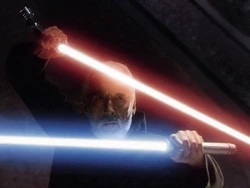
(No matter what happens in my life, I fear I will never be as cool as Sir Christopher Lee dual wielding lightsabers while humming a symphonic metal song he wrote about Charlemagne.)*
But... wha... huh... didn't you say...?
Yep. The State (as well as the Kingdom of the Left) does not use the Gospel. And the Church (as well as the Kingdom of the Right) are not tasked with the Law. Yet the Home gets to be both.
How?
Think of the Estate of the Home (or, as we could call it, the Family) as a bridge. Like this one here:
On this side, we have the State - the Kingdom of the Left.
And the Estate of the State.
On this side, we find the Church - the Kingdom of the Right.
And the Estate of the Church.
And here in the middle is the Estate of the Home.
At times, the Home must use the Law (like when a child elects to hit his a sibling with a dog) and dole out punishment appropriate. Other times, the Home uses Gospel (like when a child accidentally breaks mother's favorite knickknack) and establishes forgiveness.
Be aware, the Home is more than just the Parent-Child relationship, but also Husband-Wife, and Employer-Employee. The Home covers the entirety of the Order of Creation, which God established in Eden.
Hence why the Estate of the Home is one of the most challenging, and at times most important. (Not that the other two aren't important.) The Home is where "the rubber meets the road" so to speak. It is the practical side of this discussion. It is the Ten Commandments and the Creeds in action. In some ways it is a balancing act, having to determine when to use law and when to use gospel. Each situation and scenario is different. Part of why parenting is so difficult.
For example, I love my daughter, but if she climbs onto the dresser in the bedroom, I'm going to end up raising my voice, and possibly even disciplining her. Out of anger? No, out of love, and fear of her injuring herself. Law, to be sure, but there is forgiveness too, once the lesson is made. The gospel is without comfort if the sting of the law isn't felt. That doesn't mean running about bashing people with the law just so we can give the gospel, but until someone comes to grips with their transgression, they will not be able to fully appreciate the grace given to them in the gospel.
(And, yes, my little girl has climbed on the dresser. And, yes, she was instructed not to.)
But how about a more concrete example of the Two Kingdoms? Maybe one found in a popular movie? Perhaps finally I'll get around to exploiting the tease in the post title... tomorrow.
* Okay, so I don't actually know if he was humming a symphonic metal song about Charlemagne while on the set of Star Wars. But I do know he actually sang a symphonic metal song about Charlemagne. Actually, he produced four albums, and a number of other songs. Yes, the White Wizard sang metal at age 90. Seriously, its even on YouTube.
Wednesday, September 27, 2017
Render Unto Gary Cooper What Is Alvin York's (or) Dual Loyalties Don't Necessarily Mutually Exclude [part III]
By this point I've discussed the gist of the Two Kingdoms doctrine, and some examples in history to provide some background. Now its time to examine the tools at their disposal.
The State uses the Law.
The Church uses the Gospel.
(Post is done. Everyone go home. Good game.)
Okay, so, maybe its a little more involved than that. What is meant by Law and Gospel, in this context? Lets start with the apparently more challenging one.

The Law is a very multi-faceted issue. There are parts of it that were composed for a temporary use, while other parts have existed since before time, and a few from both categories are able to overlap, in a way. An example, perhaps?
Killing has always been wrong. But that statement is quite broad. Killing anything? Are there things we can kill? And when? Why? From the "big picture" side, all forms of death are bad, this is a philosophical issue that runs consistent. This objective truth is founded in the morality of the writer of the Law - God. All other laws are extensions of this, influenced by the context of the Fall.
That is what makes the Law a challenge to nail down. Is it wrong to kill? Yes. As a soldier who is sent to rescue POWs? Well... no, quite the opposite, in context. It is the vocation of the soldier to use force, even deadly force, but that does not mean he doesn't serve without sin, since he, like all of us, is sinful from birth. Confession and absolution is still necessary. Just because the context allows it temporally does not mean it is a "free play" existentially.
Now, ignore that cobweb riddled rabbit hole for a moment while I try to get back to the actual point.
The State's role is best summed up in Romans chapter 13. It is the job of the State to compose rules for the safety, betterment, and even control of the earthly realm. Things like speed limits, tax laws, building codes, TSA standards, sports regulations, website terms and conditions, etc.
This means it is not the State's job to forgive things. If you break a law, you are due punishment. This is appropriate. The State is tasked with being an overlord. It levies taxes, conducts war, and prosecutes criminals. Is it possible for the State to go too far? Of course. But, as I've posted before, so long as the State is within God's established boundaries, we as Christians are to faithfully serve and follow all Biblically sound laws. If the State exceeds its limits we are to seek out ways of bringing it back into those limits, preferably by legal means that do not require violence.
Now, for the actually challenging one.
The Church is tasked with forgiving sins, in the stead and by the command of Christ, who paid for all (ALL) transgressions. The Church is not given the right to form rules for life now, though they are to adhere to the Law of God, summed up in the Commandments. But the Church's primary, if not sole, role is to proclaim the Gospel. If you are at a church that does not proclaim Christ crucified as the point of every sermon and worship service... well you're probably not at a Christian church.
And here we get to why this is the more difficult one for us. With the State, there are rules, standards, codes by which to measure our actions by. We can see progress and grasp how to be "better." Its like a checklist, and we like checklists. Being able to complete a task is very rewarding. Even more so if it leads to something better. That is something the Law claims to give us: a checklist of how to be a better person. And we humans very much like that, especially us Americans. Being able to self-justify and prove we are "worthy" is, for many of us, a driving goal in life. But, in the grand scheme of salvation, it doesn't work this way. The truth is completely logical and rational, yet it is exactly opposite to what we think should be "fair," and we simply can't wrap our minds around it.
What we cannot grasp is twofold. One, the State (and by extension, the Law) cannot help us, in any way, to be a better (read: sanctified, justified) person. Two, no matter how much we keep the Law, even if someone could be completely perfect regarding any and all aspects of the Law, our only reward ultimately is Hell.
"But if God established a law to be better, and it doesn't work that way, how do we get to heaven?"
We don't get to heaven. We don't do anything. We are the lifeless person drowning in the pool. What can the drowning, unconscious man do to save himself?
The Gospel is rescue, that we are powerless to participate in. We are passive, receiving Grace that we have neither earned nor deserved. We deserve Hell. Thanks be to God that Christ came and saved us from sin, death, and our own self-serving nature.
That is the Church's duty. To proclaim the Cross and the Empty Tomb. To give us the knowledge that we are not hopeless, but saved, which frees us to be able to attempt to adhere to the law. We'll fail, but we are forgiven.
But where does Law and Gospel come to action? That is what the Three Estates is all about. Until next time...
The State uses the Law.
The Church uses the Gospel.
(Post is done. Everyone go home. Good game.)
Okay, so, maybe its a little more involved than that. What is meant by Law and Gospel, in this context? Lets start with the apparently more challenging one.
The Law is a very multi-faceted issue. There are parts of it that were composed for a temporary use, while other parts have existed since before time, and a few from both categories are able to overlap, in a way. An example, perhaps?
Killing has always been wrong. But that statement is quite broad. Killing anything? Are there things we can kill? And when? Why? From the "big picture" side, all forms of death are bad, this is a philosophical issue that runs consistent. This objective truth is founded in the morality of the writer of the Law - God. All other laws are extensions of this, influenced by the context of the Fall.
That is what makes the Law a challenge to nail down. Is it wrong to kill? Yes. As a soldier who is sent to rescue POWs? Well... no, quite the opposite, in context. It is the vocation of the soldier to use force, even deadly force, but that does not mean he doesn't serve without sin, since he, like all of us, is sinful from birth. Confession and absolution is still necessary. Just because the context allows it temporally does not mean it is a "free play" existentially.
Now, ignore that cobweb riddled rabbit hole for a moment while I try to get back to the actual point.
The State's role is best summed up in Romans chapter 13. It is the job of the State to compose rules for the safety, betterment, and even control of the earthly realm. Things like speed limits, tax laws, building codes, TSA standards, sports regulations, website terms and conditions, etc.
This means it is not the State's job to forgive things. If you break a law, you are due punishment. This is appropriate. The State is tasked with being an overlord. It levies taxes, conducts war, and prosecutes criminals. Is it possible for the State to go too far? Of course. But, as I've posted before, so long as the State is within God's established boundaries, we as Christians are to faithfully serve and follow all Biblically sound laws. If the State exceeds its limits we are to seek out ways of bringing it back into those limits, preferably by legal means that do not require violence.
Now, for the actually challenging one.
The Church is tasked with forgiving sins, in the stead and by the command of Christ, who paid for all (ALL) transgressions. The Church is not given the right to form rules for life now, though they are to adhere to the Law of God, summed up in the Commandments. But the Church's primary, if not sole, role is to proclaim the Gospel. If you are at a church that does not proclaim Christ crucified as the point of every sermon and worship service... well you're probably not at a Christian church.
And here we get to why this is the more difficult one for us. With the State, there are rules, standards, codes by which to measure our actions by. We can see progress and grasp how to be "better." Its like a checklist, and we like checklists. Being able to complete a task is very rewarding. Even more so if it leads to something better. That is something the Law claims to give us: a checklist of how to be a better person. And we humans very much like that, especially us Americans. Being able to self-justify and prove we are "worthy" is, for many of us, a driving goal in life. But, in the grand scheme of salvation, it doesn't work this way. The truth is completely logical and rational, yet it is exactly opposite to what we think should be "fair," and we simply can't wrap our minds around it.
What we cannot grasp is twofold. One, the State (and by extension, the Law) cannot help us, in any way, to be a better (read: sanctified, justified) person. Two, no matter how much we keep the Law, even if someone could be completely perfect regarding any and all aspects of the Law, our only reward ultimately is Hell.
"But if God established a law to be better, and it doesn't work that way, how do we get to heaven?"
We don't get to heaven. We don't do anything. We are the lifeless person drowning in the pool. What can the drowning, unconscious man do to save himself?
The Gospel is rescue, that we are powerless to participate in. We are passive, receiving Grace that we have neither earned nor deserved. We deserve Hell. Thanks be to God that Christ came and saved us from sin, death, and our own self-serving nature.
That is the Church's duty. To proclaim the Cross and the Empty Tomb. To give us the knowledge that we are not hopeless, but saved, which frees us to be able to attempt to adhere to the law. We'll fail, but we are forgiven.
But where does Law and Gospel come to action? That is what the Three Estates is all about. Until next time...
Tuesday, September 26, 2017
Render Unto Gary Cooper What Is Alvin York's (or) Dual Loyalties Don't Necessarily Mutually Exclude [part II]
Okay, kiddos, lets get ready to time travel. Please make sure your seat belts are fastened and keep your arms, legs, heads, and left rib inside the blog at all times. If you forgot to sign the waiver... too late now.
So, historic examples of the Kingdom of the Left and the Kingdom of the Right.
Alright, so here's the "quick and dirty" version. God established a covenant with Israel at Sinai. After entering the Promised Land the nation of Israel spent quite a while conquering and reconquering the territory. During this time they were led by judges and the priests, who spoke God's commands to them.
Finally, they requested a king, and reluctantly God gave them one, Saul. After him came David, whose line continued to rule until Jerusalem's fall in 586. Well, except for the northern 10 tribes, who rebelled and formed their own nation in 910. (They'd be gone by 722.)
Israel was, initially, a kind of theocracy. God was their king, with day-to-day political duties being handled by the Law, and by people like Moses or Joshua. The Law, the big version that takes up most of Leviticus, Numbers, and Deuteronomy, was a combination of civic, ceremonial, and moral. The first two were specific for the Israelites within their covenant. The moral, the 10 Commandments, were preexisting, and are still in play. (Not that the rest of it is/was bad, but that's a different post.)
The Two Kingdoms were (or were supposed to be) intertwined in ancient Israel. To use the monarchial metaphor, it was a real union, as opposed to a personal union. And so long as Israel followed God as both Lord and King, things went well, including when the kings were good (ya know, guys like David, Asa, Hezekiah). Israel is the poster child for this concept, not so much in its actual form but in the intention. Hence why this symbol/prototype is used in the New Testament by the likes of Paul, Peter, the write of Hebrews, and Jesus.
Next up: Rome! The empire started in 27 BC, and ended in 395 AD (with the split), 480 AD (with the ending of the Western empire), and 1453 AD (when the Easter/Byzantine empire fell). And, yes, the Byzantine overlaps with the Middle Ages, but that's not relevant right now. The only Roman empire I'm concerned with at this moment is the versions from its founding to the fall of the city of Rome in 476. And there are technically (for my purpose) two: the version founded by Julius Caesar, and the one reformed by Constantine.
In the "classic" Roman empire, the church/state dichotomy was complicated. And I'm ignoring the pagan worship for this. Not because it isn't significant in the empire's formation. But because it adds complexity that isn't needed for this topic. At least right now. But the nice thing is the situation is easy to sum up:
"Then He [Jesus] said to them, 'Therefore render to Caesar the things that are Caesar's, and to God the things that are God's."" (Matthew 22:21.)
This point is brought up in detail by St. Paul in Romans chapter 13. But we will dig deeper there later. For now, the gist is that in early Rome, when the empire was still hostile toward Christians, the Church had to live both within the Kingdoms of the Left and the Right.
In many ways things got better when Constantine what at the helm, but only because the killing of Christians wasn't government sanctioned anymore. The church had other issues on its hands, like major heresies. You know, the ones self-proclaimed "experts" seem to think was "original Christianity" before the councils forced the church to adopt certain ideas about Jesus being God, and other controversial things that are now considered baseline.
(I shouldn't need to take the time to call these guys out, I'll save that for another day. But if the guy you're using as a source thinks a gnostic gospel is 300+ years older than the synoptics, then he should be forced to listen to the first half of the baby back ribs song. Check Scrubs if you don't know that one.)
And now, ladies and gentlemen, for the Medieval period! Sometimes it is (incorrectly) called the Dark Ages or the Middle Ages, this slice of time went from the 5th century (400s) through the 15th century (1400s). Basically from the fall of Rome to the start of the Renaissance.
(By the way, it was Renaissance thinkers who called it the "dark" ages, to imply that they were backward in thought somehow. Arrogant of them, but, that's for a different post.)
The Medieval period covers a lot of things. The kingdom of Charlemagne. The Crusades. The forming of the Holy Roman Empire. The Vikings. The "classic" era of English history (here be knights in shining armor and rogues wearing tights). The voyage of Marco Polo. If you want a feel for the era, check out A Knight's Tale. Anachronistic, sure, but is pretty honest with tournaments. Otherwise, just look up Mike Loades on YouTube. If watching a man in his 60s get knocked off a horse while sword-fighting and giggling in the dirt is your thing, you'll like his work.
The Middle Ages (and its extensions the Renaissance and the Reformation) have common "flavors." One thing that we will focus on is the overlap of Church and State.
The Holy Roman Empire was reestablished in 962 under Otto I. The pope crowned him, and declared him emperor of the Romans. Why? In part as a gambit to combat the Muslims. Remember, at this time, the Muslim world is expanding through North Africa, and is nearing places like Spain and Greece. That understandably scared people in Europe, the Islamic religion being irrelevant initially. Didn't remain irrelevant, but the Crusades are not where I'll dig too much today. Mostly because we don't have time, and I dare not dedicate that many pixels to the topic.
Crusades were called, sometimes sanctioned by the church in Rome. Primarily for the politics first, and the faith-based reason second. People would do good to remember that. But, in that day and age, state and religion were not separable.
Your lord (king, duke, count, prince, etc) determined which religion you (the serf) practiced. And in that day there was only one: Catholicism. Well, at least until the Great Schism in 1054, which made the choice Roman Catholic or Eastern Orthodox. But, regardless, the lord was to be a defender of the faith. Church and State were side-by-side. It gets muddy, though, when you head to Italy to visit the bishop of Rome.
Now, this will upset some, but if you've been reading anything here, it shouldn't surprise. The Papacy of the Middle Ages was operating heretically. One because it claimed to have authority to hold authority in both civic and ecumenical aspects (they've dialed this back), and have authority equal to Scripture (they still believe this). The Pope controlled a large portion of Italy, had an army, and could decide who was to be crowned king or emperor.
Regardless of what you think of that medieval mess, the church and state were so intertwined that it never occurred to anyone to think of themselves as anyone but a Christian, which was both their faith and national identity. In fact, national identity didn't really exist until the late 15th century. Guys like Dr Luther had a lot of influence on the concept of national identity (both good and bad).
And now, the bonus: our modern mess, the American States that are United.
In reality, all I need to address is the whole "separation of church and state" line of the Constitution. Only, its not in the Constitution. Rather, the phrase is in a letter by Thomas Jefferson, explaining the amendment granting people free practice of religion. The founder said there is a wall separating the church and state.
You see, the letter was a response to a religious group who were worried the government would go to them and say "you need to conform to the national religion or pay a fine." (This sort of think happened in England. Part of why the Pilgrims left.) They wrote to Jefferson hoping for support. He responded with an explanation that the Constitution does not allow the State to have say in the affairs of the Church.
You hear that politicians? "Separation of Church and State" defends the church from the state. And before you be all like "oh, history shows us religion takes over governments" (which has happened), may I remind you what happened in Nazi Germany? Hitler forcibly took over the churches. That's why Christians get so upset and worried about politicians supporting things like Planned "Parenthood," insurance rules that required purchasing contraceptives, and calls for us to "tolerate" something we believe is wrong.
That's why this discussion is needed. There is a middle ground, but getting there isn't easy. But it requires knowing how the State and the Church have authority, and what tools are at their disposal.
Tune in tomorrow...
So, historic examples of the Kingdom of the Left and the Kingdom of the Right.
- The Kingdom of Israel.
- The Roman Empire.
- The political mess we call the Middle Ages.
- (Bonus!) The, at times, ridiculous experiment in contradictions we call the United States.
Alright, so here's the "quick and dirty" version. God established a covenant with Israel at Sinai. After entering the Promised Land the nation of Israel spent quite a while conquering and reconquering the territory. During this time they were led by judges and the priests, who spoke God's commands to them.
Finally, they requested a king, and reluctantly God gave them one, Saul. After him came David, whose line continued to rule until Jerusalem's fall in 586. Well, except for the northern 10 tribes, who rebelled and formed their own nation in 910. (They'd be gone by 722.)
Israel was, initially, a kind of theocracy. God was their king, with day-to-day political duties being handled by the Law, and by people like Moses or Joshua. The Law, the big version that takes up most of Leviticus, Numbers, and Deuteronomy, was a combination of civic, ceremonial, and moral. The first two were specific for the Israelites within their covenant. The moral, the 10 Commandments, were preexisting, and are still in play. (Not that the rest of it is/was bad, but that's a different post.)
The Two Kingdoms were (or were supposed to be) intertwined in ancient Israel. To use the monarchial metaphor, it was a real union, as opposed to a personal union. And so long as Israel followed God as both Lord and King, things went well, including when the kings were good (ya know, guys like David, Asa, Hezekiah). Israel is the poster child for this concept, not so much in its actual form but in the intention. Hence why this symbol/prototype is used in the New Testament by the likes of Paul, Peter, the write of Hebrews, and Jesus.
Next up: Rome! The empire started in 27 BC, and ended in 395 AD (with the split), 480 AD (with the ending of the Western empire), and 1453 AD (when the Easter/Byzantine empire fell). And, yes, the Byzantine overlaps with the Middle Ages, but that's not relevant right now. The only Roman empire I'm concerned with at this moment is the versions from its founding to the fall of the city of Rome in 476. And there are technically (for my purpose) two: the version founded by Julius Caesar, and the one reformed by Constantine.
In the "classic" Roman empire, the church/state dichotomy was complicated. And I'm ignoring the pagan worship for this. Not because it isn't significant in the empire's formation. But because it adds complexity that isn't needed for this topic. At least right now. But the nice thing is the situation is easy to sum up:
"Then He [Jesus] said to them, 'Therefore render to Caesar the things that are Caesar's, and to God the things that are God's."" (Matthew 22:21.)
This point is brought up in detail by St. Paul in Romans chapter 13. But we will dig deeper there later. For now, the gist is that in early Rome, when the empire was still hostile toward Christians, the Church had to live both within the Kingdoms of the Left and the Right.
In many ways things got better when Constantine what at the helm, but only because the killing of Christians wasn't government sanctioned anymore. The church had other issues on its hands, like major heresies. You know, the ones self-proclaimed "experts" seem to think was "original Christianity" before the councils forced the church to adopt certain ideas about Jesus being God, and other controversial things that are now considered baseline.
(I shouldn't need to take the time to call these guys out, I'll save that for another day. But if the guy you're using as a source thinks a gnostic gospel is 300+ years older than the synoptics, then he should be forced to listen to the first half of the baby back ribs song. Check Scrubs if you don't know that one.)
And now, ladies and gentlemen, for the Medieval period! Sometimes it is (incorrectly) called the Dark Ages or the Middle Ages, this slice of time went from the 5th century (400s) through the 15th century (1400s). Basically from the fall of Rome to the start of the Renaissance.
(By the way, it was Renaissance thinkers who called it the "dark" ages, to imply that they were backward in thought somehow. Arrogant of them, but, that's for a different post.)
The Medieval period covers a lot of things. The kingdom of Charlemagne. The Crusades. The forming of the Holy Roman Empire. The Vikings. The "classic" era of English history (here be knights in shining armor and rogues wearing tights). The voyage of Marco Polo. If you want a feel for the era, check out A Knight's Tale. Anachronistic, sure, but is pretty honest with tournaments. Otherwise, just look up Mike Loades on YouTube. If watching a man in his 60s get knocked off a horse while sword-fighting and giggling in the dirt is your thing, you'll like his work.
The Middle Ages (and its extensions the Renaissance and the Reformation) have common "flavors." One thing that we will focus on is the overlap of Church and State.
The Holy Roman Empire was reestablished in 962 under Otto I. The pope crowned him, and declared him emperor of the Romans. Why? In part as a gambit to combat the Muslims. Remember, at this time, the Muslim world is expanding through North Africa, and is nearing places like Spain and Greece. That understandably scared people in Europe, the Islamic religion being irrelevant initially. Didn't remain irrelevant, but the Crusades are not where I'll dig too much today. Mostly because we don't have time, and I dare not dedicate that many pixels to the topic.
Crusades were called, sometimes sanctioned by the church in Rome. Primarily for the politics first, and the faith-based reason second. People would do good to remember that. But, in that day and age, state and religion were not separable.
Your lord (king, duke, count, prince, etc) determined which religion you (the serf) practiced. And in that day there was only one: Catholicism. Well, at least until the Great Schism in 1054, which made the choice Roman Catholic or Eastern Orthodox. But, regardless, the lord was to be a defender of the faith. Church and State were side-by-side. It gets muddy, though, when you head to Italy to visit the bishop of Rome.
Now, this will upset some, but if you've been reading anything here, it shouldn't surprise. The Papacy of the Middle Ages was operating heretically. One because it claimed to have authority to hold authority in both civic and ecumenical aspects (they've dialed this back), and have authority equal to Scripture (they still believe this). The Pope controlled a large portion of Italy, had an army, and could decide who was to be crowned king or emperor.
Regardless of what you think of that medieval mess, the church and state were so intertwined that it never occurred to anyone to think of themselves as anyone but a Christian, which was both their faith and national identity. In fact, national identity didn't really exist until the late 15th century. Guys like Dr Luther had a lot of influence on the concept of national identity (both good and bad).
And now, the bonus: our modern mess, the American States that are United.
In reality, all I need to address is the whole "separation of church and state" line of the Constitution. Only, its not in the Constitution. Rather, the phrase is in a letter by Thomas Jefferson, explaining the amendment granting people free practice of religion. The founder said there is a wall separating the church and state.
You see, the letter was a response to a religious group who were worried the government would go to them and say "you need to conform to the national religion or pay a fine." (This sort of think happened in England. Part of why the Pilgrims left.) They wrote to Jefferson hoping for support. He responded with an explanation that the Constitution does not allow the State to have say in the affairs of the Church.
You hear that politicians? "Separation of Church and State" defends the church from the state. And before you be all like "oh, history shows us religion takes over governments" (which has happened), may I remind you what happened in Nazi Germany? Hitler forcibly took over the churches. That's why Christians get so upset and worried about politicians supporting things like Planned "Parenthood," insurance rules that required purchasing contraceptives, and calls for us to "tolerate" something we believe is wrong.
That's why this discussion is needed. There is a middle ground, but getting there isn't easy. But it requires knowing how the State and the Church have authority, and what tools are at their disposal.
Tune in tomorrow...
Monday, September 25, 2017
Render Unto Gary Cooper What Is Alvin York's (or) Dual Loyalties Don't Necessarily Mutually Exclude [part I]
Buckle up, kids, I'm going to talk about a somewhat controversial subject: the left and the right.
(cue likely assumption that I mean politics)

In case my spontaneous use of snarky Spaniards doesn't reveal I'm not talking about the political "left" and "right," then either the world is too focused on politics or I've written too much about the topic myself.
As a very wise philosopher once said: "¿Por qué no tenemos ambos?"
But seriously, I wanna talk about the left and right.
A few months ago my wife and I traveled to Denver for a conference on the Two Kingdoms doctrine and the Three Estates.
...
I can tell by the crickets that some of you are unfamiliar. That's okay, it is a bit of inside baseball. The short version is there are two authorities ruling this world, but in very differing ways, and there are three entities by which these authorities interact with us.
So, a primer first. And, yes, I'm stealing/borrowing from the Steadfast Conference and Dr. Luther's Small Catechism.
First, the Two Kingdoms: The Left (State/Secular) and the Right (Church/Spiritual).
Please don't assume that when I use the terms "left" and "right" I'm talking about what Americans mean politically. In this context left does not mean "socialist/anarchist/communist/un-American/liberal," just as right does not mean "conservative/fascist/nationalist/patriot/capitalist." The reasons for the left/right dichotomy is much simpler. We just don't remember it in a post-monarchy western world.
Back in the day, to sit at the king's right hand was a place of authority and power. Often the heir apparent sat there. It didn't mean the left was a bad position, but the symbolism of being the king's "right hand" (which was often his dominant hand) was self-evident. If you live in an era where the sword is the sidearm of choice, where do you want your most trusted advisor and warrior to sit, to represent that he (or she, if applicable) is your most powerful asset?
Not points for guessing the obvious answer, especially since giving the obvious answer is all teaching is. (But that's beside the point.)
When Luther used the Left and Right, he wasn't making commentary on political policies. Rather, he was showing how God uses both the State and the Church as His emissaries. Left and Right are merely shorthand.
So, what is the difference between the two?
Well, first, to quote Yoda, you must unlearn what you have learned (at least a little). You will need to see things from a more historic perspective, placing yourself in previous realities, not just viewing this from the lens of 21st century America (or wherever you hail from). Why? Because most of us living in a post-modern reality have this idea of how Church and State don't mix and mingle. Of how there is this idea of religious liberty and tolerance of worship styles. Now, these are not bad, but operating under a thought process that is influenced by this understanding will have the potential to lead this discussion astray.
Now, with that in mind, we will take a trip back in time. We'll stop in the Middle Ages, in the Roman Empire, and in the Kingdom of Israel. Why? To see examples from each of how the State and the Church work side by side, and even interconnect. Whether they should or shouldn't.
But, that will have to wait until tomorrow.
(cue likely assumption that I mean politics)
In case my spontaneous use of snarky Spaniards doesn't reveal I'm not talking about the political "left" and "right," then either the world is too focused on politics or I've written too much about the topic myself.
As a very wise philosopher once said: "¿Por qué no tenemos ambos?"
But seriously, I wanna talk about the left and right.
A few months ago my wife and I traveled to Denver for a conference on the Two Kingdoms doctrine and the Three Estates.
...
I can tell by the crickets that some of you are unfamiliar. That's okay, it is a bit of inside baseball. The short version is there are two authorities ruling this world, but in very differing ways, and there are three entities by which these authorities interact with us.
So, a primer first. And, yes, I'm stealing/borrowing from the Steadfast Conference and Dr. Luther's Small Catechism.
First, the Two Kingdoms: The Left (State/Secular) and the Right (Church/Spiritual).
Please don't assume that when I use the terms "left" and "right" I'm talking about what Americans mean politically. In this context left does not mean "socialist/anarchist/communist/un-American/liberal," just as right does not mean "conservative/fascist/nationalist/patriot/capitalist." The reasons for the left/right dichotomy is much simpler. We just don't remember it in a post-monarchy western world.
Back in the day, to sit at the king's right hand was a place of authority and power. Often the heir apparent sat there. It didn't mean the left was a bad position, but the symbolism of being the king's "right hand" (which was often his dominant hand) was self-evident. If you live in an era where the sword is the sidearm of choice, where do you want your most trusted advisor and warrior to sit, to represent that he (or she, if applicable) is your most powerful asset?
Not points for guessing the obvious answer, especially since giving the obvious answer is all teaching is. (But that's beside the point.)
When Luther used the Left and Right, he wasn't making commentary on political policies. Rather, he was showing how God uses both the State and the Church as His emissaries. Left and Right are merely shorthand.
So, what is the difference between the two?
Well, first, to quote Yoda, you must unlearn what you have learned (at least a little). You will need to see things from a more historic perspective, placing yourself in previous realities, not just viewing this from the lens of 21st century America (or wherever you hail from). Why? Because most of us living in a post-modern reality have this idea of how Church and State don't mix and mingle. Of how there is this idea of religious liberty and tolerance of worship styles. Now, these are not bad, but operating under a thought process that is influenced by this understanding will have the potential to lead this discussion astray.
Now, with that in mind, we will take a trip back in time. We'll stop in the Middle Ages, in the Roman Empire, and in the Kingdom of Israel. Why? To see examples from each of how the State and the Church work side by side, and even interconnect. Whether they should or shouldn't.
But, that will have to wait until tomorrow.
Subscribe to:
Posts (Atom)