Showing posts with label Writings. Show all posts

Wednesday, October 11, 2017

Would He Walk 500 Miles, Then 500 More, Just To Be A Hero? (or) This Feels Like Deja Vu, Or Deja Vu Of Deja Vu

So, everyone is still talking about how "The Force Awakens" was just a remake/reboot of "A New Hope," and how it looks like the sequel will be a carbon-copy of the original sequel.

But is it?

And if it is, is that bad?

And if it isn't, is that good?

No, no/kinda, maybe.

I will start with the second question.  "Is that bad (that TLJ is a remake/reboot of ESB)?"  No.  Or kinda.  Or both.  How can it be both?  Mythology.

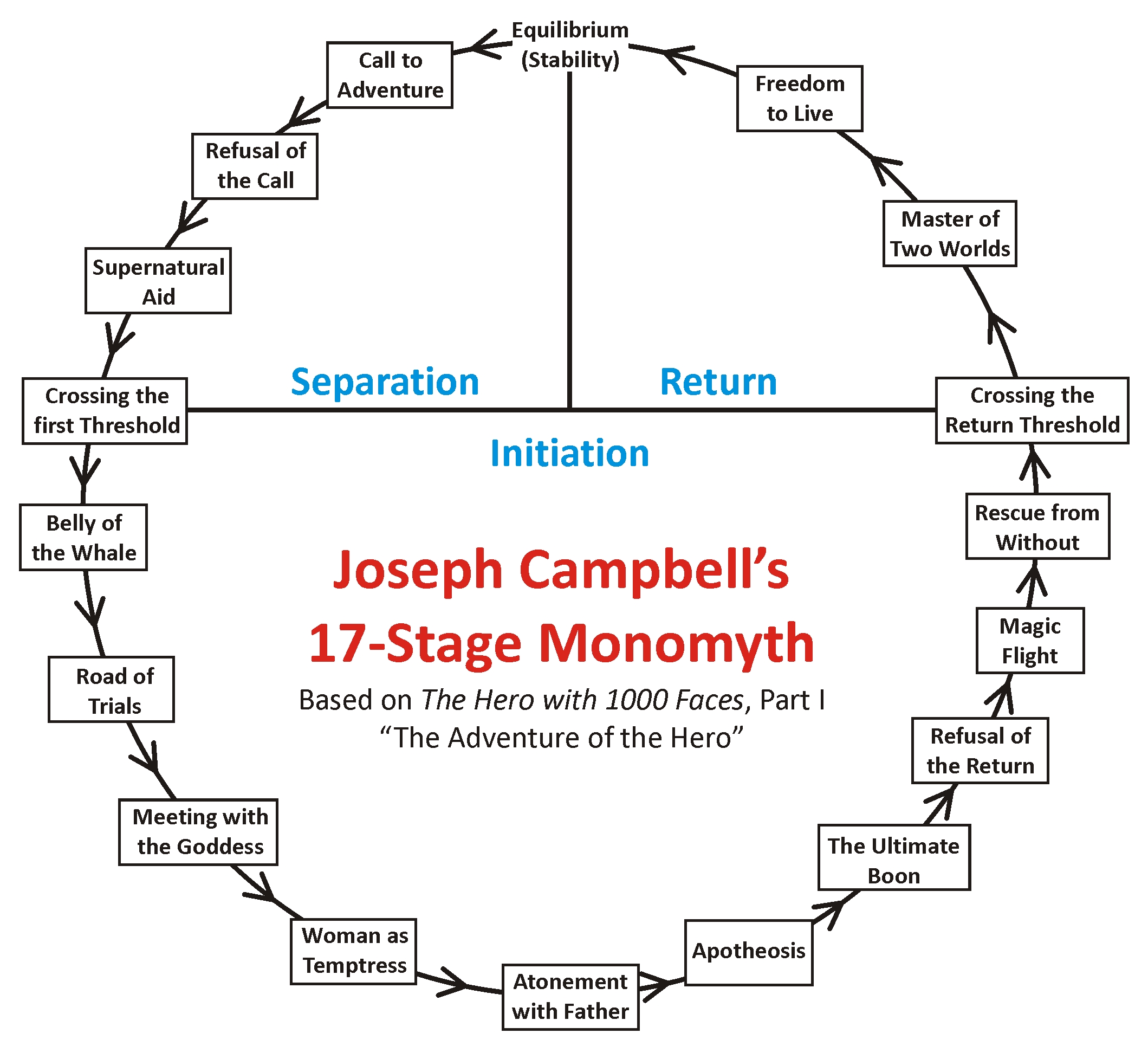
If you look about at the classic myths (Greece, Rome, Norse, etc) you will see similar stories, heroic types, monsters, and themes.  Joseph Campbell, who studied mythologies, noticed these common items and wrote a book about it: The Hero With A Thousand Faces.  In it he describes the "monomyth" (sometimes also called "the hero's journey").  Not all "saga-type" stories adhere to all the parts, and not all follow in the prescribed order, but stories that feature these archetypes tend to feel big and epic.  Campell's work influenced a number of storytellers.

Including an innovative film maker in the 1970s with a story he called "Star Wars."

While wiki may be be a "better" way to learn about this, the TV Tropes site has a good article too.  (Right here -> The Hero's Journey)  There are seventeen steps.

The gist is this:
  • Act 1 - Departure - the hero leaves the familiar world behind
  • Act 2 - Initiation - the hero learns to navigate the unfamiliar world of adventure
  • Act 3 - Return - the hero returns to the familiar world

I could sum these three up with quotes from the original Star Wars trilogy.
"You must learn about the Force, if you are to come with me to Alderaan."
"There you will learn from Yoda, the Jedi master who instructed me."
"No more training, do you require. Already know you that which you need."
The original trilogy follows Luke, and his plot adheres to the Monomyth cycle quite nicely.  You want examples?  Very well.

Miraculous or circumstances surrounding hero's conception/birth:  He's a twin.  (Granted, we don't know this initially, but his being an orphan counts sort of as half point here.)

A herald brings The Call to adventure: R2 and the message from the princess.  This leads directly to...

Refusing The Call: its not that he likes the Empire, but there's nothing he can do about it.

Crossing the first threshold: Could be the destruction of the homestead, or the flight from Tatooine.  Either way, its a rapid and violent break from the "safe" place he was in.

There are many more categories, and even subcategories.  They aren't needed for a good story, but many good stories do have some aspects of the cycle.

Now I fully believe that the guys and gals at Lucasfilm are on the right track emulating the original trilogy.  Why?  'Cause it works.  And since they are operating out of the monomyth cycle playbook, and in the Star Wars universe to boot, things will look very similar.  Hence the answer to my third question, "is that good," because it might be.

Now, I think it is, and am willing to give them the benefit of the doubt (for now).  But, let's see if they really are adhering to the cycle.  Let's examine if the main character is on the Hero's Journey, based only on TFA.
  • The Call to Adventure - BB-8 shows up on Jakku and needs help from Rey.  At Niima Outpost they run into Finn.
  • Refusal of the Call - Rey is hesitant to assist BB-8, and especially unhappy to work with Finn (initially).  After hijacking the Falcon she wants to go back to Jakku.
  • Supernatural Aid - BB-8, Finn, Han Solo, Maz Kanata all could count.  The Force, most obviously.
  • Crossing the First Threshold - Hijacking the Falcon during the attack.
  • Belly of the Whale - The vision with the Skywalker Lightsaber.  The torture Rey endured from Kylo Ren, including her ability to turn it around.  Somewhat literally would be the Falcon being taken aboard Han and Chewie's new ship, and the subsequent "adventure" with rathtars.
  • The Road of Trials - Rey first "tapping" into her powers, but reverse-interrogating Kylo Ren.
  • Meeting with the Goddess/Love - Both Finn and Han showing her that they care.  In the former regarding her safety.  With the latter regarding offering her a job.  Both willingly go to save her.
  • Temptation - The desire to return to Jakku is one, but so is Kylo Ren's offer to train Rey.
  • Atonement with the Hero’s Father - Rey hasn't experienced this yet, I think.
  • Peace and Fulfillment Before the Hero’s Return - Rey coming to accept that whoever she's been waiting for on Jakku won't be back.
  • The Ultimate Boon - If the lightsaber fight didn't prove she's gonna be a Jedi...
  • Refusal of the Return - She doesn't go back to Jakku, but travels to Ahch-To to train with Luke.
  • Magic Flight - Escaping from the cell using a Jedi mind trick.
  • Rescue from Without - The Falcon showing up to rescue Rey and Finn after the lightsaber fight.
  • Return - Viewing the map at the Resistance base.
  • Master of Two Worlds - Not yet.
  • Freedom to Live - Moving forward after losing her home, her father figure, and almost losing her best friend.

Now, this is just me, being a nerd.  It isn't official, and I may be wrong, but since I see the similarities, especially in the storytelling methods, as strengths, it makes the story more enjoyable.  That's one advantage of writing fiction.  I have grown a greater appreciation for the craft, the art, the science of storytelling.

So, no, The Last Jedi isn't a "remake/reboot" of The Empire Strikes Back.  There will be many similarities, in part because it has been a considerable time since the originals came out.  And since the First Order is the heir of the Empire, it makes sense they'd use similar but improved methods and weapons.  To complain about the "Death Star 3" and such would be like complaining that a movie on tanks in Desert Storm was just a ripoff of a movie on the Battle of the Bulge because the tanks are obviously just "bigger" versions of the old ones, used in basically the same way.

Sounds silly because it is.

Besides, at the end of the day, if you're still feeling salty about it, just repeat the Mystery Science Theater 3000 mantra:

Until Dec. 15, remember to keep calm and carry on, and enjoy an ice cold Fanta... on me, of course.

Saturday, September 30, 2017

To Be Continued... (or) If This Works, I Could Upstage Indiana Jones

First off... a ridiculously huge thanks go out to Capt. Kirk and all the gang at KNNA.  Thank you for playing my story.  Hopefully I can have more of the story ready to air soon.

Second, and somewhat hilariously, I'm more upset at the Capt. mispronouncing Wagner than my name (long "au" sound).  A little curious what he used for music.  Oh well.

You can find the link to the show archive here, or just goes straight to the show itself here.  The story isn't read until the last half hour (if you want to skip ahead, its around the 93 minute mark, I think).

Let me know what you think.  Want to hear more?  Want the transcript posted here?  Know what music he used?  Comments and critiques welcomed.

Friday, September 22, 2017

Aviators, Germans, Mermaids, And Pirates - Oh My (or) Shameless Simultaneous Plug For Both Future Novel And Current Radio Program

Extra!  Extra!  Read all about it!

Next week Tomorrow (Sat. Sept 30 23) a portion of my most recent story I've been tinkering with will be read on the radio.  It will be on KNNA (95.7 FM), a local station here in Nebraska, started by some members at Good Shepherd LCMS.  Being a low power station you really can't hear it too far outside the Lincoln city limits (sadly).  But they have a website, and an app, so the rest of us can listen live or even listen to archived shows.

The show the excerpt will be read on is called Soundtrack Telling.  Its a two hour show starting at 7 am, that plays soundtrack music from movies, shows, video games, and trailers.  The host, Capt. Kirk, usually reads story either he has been writing, or a viewer writes, during the second hour, which he will pair with background music.  I have no idea what mine will be paired with.

You can find their website here (http://thecross957.org/) or you can visit the show archives and listen to previous episodes of Soundtrack Telling here: (http://thecross957.org/soundtracktelling/).

They have other shows too.  They rebroadcast Issues Etc., Table Talk Radio, and a few podcasts (such as Gospeled Boldly).  Some of their original shows include Off On A Tangent (where they have no idea what they are doing) and When Music Was Music (where Ol' Lovable Jack plays hits from the Big Band era).

And, yes, today's title is a bit of a hint regarding the story.  But that's all I'll say for now.

So, yep, tomorrow next Saturday, 7 am, 95.7 FM.  Be there or listen to it archived later.  Maybe I'll have the next section finished and able to send in to read... or maybe I'll just leave y'all hanging until the story is ready to publish.


***

*Edit:  Okay.  Checking my email after work revealed that, due to unforeseen circumstances, there will not be a new Soundtrack Telling episode on Sat. Sept. 23.  My story is still to be read, but not until next week.

Saturday, April 12, 2014

The Time Splice

What do H. G. Wells, Dr. Emmett Brown, and your's truly (Adam) have in common?

We've all invented (or discovered) time machines.  Yes, that's right, I have a time machine.  Two of them, in fact.  And they both work differently.

Okay, so one of them is actually just a pen.  Specifically its a Zebra F-301 Compact.  That might not seem important, but you'll see (maybe) that it is.  Anyway, yes, my time machine is a pen.  Why a pen?  How can a lowly pen be a time machine?

Well, with my pen I can write stories.  Stories about any time and place.  So, metaphorically, my pen is a time machine.

"But Adam, you said you have two time machines?"

Yes.  Along with occasionally speaking to myself in the third person, I do have a second time machine.  Actually, that's not entirely accurate.  I have a second method of building a time machine.  It's actually really nifty.

Now, I am an amateur internet archeologist and part-time mad scientist, so it should come as no surprise when I say this: I found the long lost and supposedly fictional notebooks of the infamously famous Quattrocento alchemist Eliseo Uroboros.

No, really, I did.

Eliseo Uroboros is the guy who claimed to have discovered time travel.  His notebooks include numerous techniques for using esoteric elements such as janusite, chronosite, aionite, and horaeum.  For centuries, most scientists, and even a few alchemists, dismissed work with these elements as dangerous.  Especially chronosite, which is know to spontaneously spark and even occasionally explode, if in large enough amounts.

But Uroboros was determined to prove that chronosite could be a power source for something.  What he discovered was completely by accident.  According to his notes, on January 13, 1432, he was conducting an experiment with aionite.  He was heating a piece the size of his thumb over a charcoal flame when the piece exploded.  One of the shards shot out and struck a piece of chronosite that was sitting on the workbench nearby.  The collision resulted in a very strange explosion.  Everything within ten feet of where the chronosite rested disappeared.

When Uroboros picked himself off the floor, he went about cleaning up the mess made by the explosion.  Well, he would have, if there was anything left by the explosion.  You see everything within ten feet was gone.  Not destroyed, but, poof, gone.  His notes, experiments, tools, and workbench were all gone.  What was left of his workbench had a ten foot wide circular hole.  The stone floor even had a dent in it, as if a giant sphere had fallen.

Without an explanation, Uroboros returned to his other experiments.  Nearly two years passed before he figured out what had happened that day.  He was trying to see if chrysoberyl could be used as a lens for a heat ray when a flash of bright light stuck his workshop.  At first he thought it was lightning, or that the local Dominican friar was right and God was trying to strike him dead.  As soon as the blurry spots left his vision he was greeted with the most amazing sight: a perfectly circular cutout of his old workbench, complete with all the tools, experiments, and notes that were on it.

Perplexed and intrigued, Uroboros investigated.  Everything that he had placed on the bench two years prior was right where he left it.  Except the chronosite.

After a bit of thinking (and a fair amount of his neighbor's wine to settle his nerves), Uroboros determined that, somehow, the combination of chronosite and aionite was able to transfer things through time.  Over the next five years Uroboros experimented with a variety of quantities and collision methods, determining how this time travel worked and how to control it.  His work was crude, but he was able to figure out that the combination of chronosite and aionite has a "range" of between 100 to 2,000 years.  His first device was designed to work like a gun.  After setting the date all one had to do was press the button.  Uroboros crafted many Time Splices, each using a different method of colliding chronosite and aionite.  A few of these were successful, while others were spectacular failures.

In his lifetime, Uroboros never figured out how, exactly, the Time Splice worked.  All he knew was that the explosive combination of the two elements allowed a person to travel through time.  Very few have tried to study his device.  But I figured out how it works.  What Uroboros did not know was astrophysics and nuclear weaponry.

What happens when a nuclear bomb goes off?  (Besides saying "it explodes, duh.")  The explosion creates a runaway fission or fusion reaction, depending on the type of bomb.

What happens when a star dies?  Sometimes, the matter collapses into a super-dense area that has immense gravity - a black hole.  Other times the star explodes, creating a supernova.

What happens when the Time Splice is activated?

The Time Splice is a nuclear fusion device.  Yes, a Renaissance era alchemist accomplished what numerous modern scientists cannot.  Don't start thinking that this can be used for the making of unlimited electricity.  Time Splices are both inherently unstable and self-destructive to a degree.  Let me explain how it works.

The combination of aionite and chronosite in the core acts as both the fusional material and the “portal” for time travel.  When engaged, the Time Splice will go through a near instantaneous four part process.
  1. The Time Splice core is “spun up,” with the aionite colliding with the chronosite.  This creates a “point” of nuclear fusion in the form of a micro star less than 1 cm in diameter.
  2. The micro star reaches critical mass and collapses, creating a micro black hole, roughly ten feet in diameter.  This black hole is what severs the traveler’s timeline.
  3. The micro black hole self-detonates and expands outwardly, creating a white hole.
  4. The white hole collapses, splicing the traveler’s timeline.
The black hole is what “destroys” or “collapses” the local space-time, thus severing the traveler’s timeline.  The white hole is a “reversed” black hole that “explodes” outward in the local space-time, thus “splicing” the traveler’s timeline sometime else.  Everything within the ten feet of the time splice is transported.  This makes using the Time Splice somewhat problematic.  For example, if you were to use a Time Splice while in the back seat of a car, the driver will be upset that his car looks like a shark tried to eat it.

There are three types of Time Splices: gun, torus, and globe.  These types are similar to nuclear weaponry.  Gun, or rod-type, is similar to the "Little Boy" bomb.  An aionite "bullet" is "shot" at a cylindrical chronosite crystal.  This is most similar to the accidental Time Splice created in Uroboros's lab.  Torus, or ring-type, is like the current experiments for nuclear fusion.  It uses a circular shaped chronosite crystal.  The aionite is collided in the same way as a particle accelerator.  Torus-type Time Splices tend to be the safest.  They have more range than the gun-type, which are often "one-way."  The collision of aionite and chronosite, like almost all things nuclear, results in the destruction of the material.  This means that either the time traveler needs to bring extra fuel along, or use a gun-type as a "back up" device.  Torus-type Splices can be used more than once before the chronosite is fully depleted.  The globe, or ball-type, is rare.  They have the longest range, due to being similar to implosion-method nuclear weapons.  Also, since they are large, they are less convenient to use.

Time Splices can be made to look like anything.  Except perhaps a DeLorean.  Most gun-type Splices look like a pen, such as a Zebra F-301 Compact.  Torus-types often are seen, ironically, as watches.

There is a catch to using Time Splices.  Unlike the fictional time machines, the Time Splice cannot change date or hour, only the year.  So, if you want to see the opening of "Macbeth" in the original Globe theater, you will need to travel to London and be there on the correct date.  Once there, select the destination year and go.

When Time Traveling, there are no sights or sounds.  It is instantaneous.  One second you're in 2014, the next your in 1492.  The most often side-effect is a sense of vertigo.

That's what I've discovered so far.  I'm not sure what all the limitations are yet, but I did find a note that suggests that time travel only works from a later time to a lesser time.  What I mean is I can travel back to the past but not forward to the future.  I am also cautions because of the possibility of changing the past.  Under no circumstances am I going to try to go back in time and stop (insert significant historic event here) from happening.  If "Back to the Future" has taught us anything it is to not keep your parents from meeting.  The consequences could include erasing that one random photograph of you and your siblings that you have, and even having your hand start to disappear.

If you want, I can write about my adventures across time.  Or even better, I can tell you the adventures of a friend of mine.  He was researching the Second World War.  Maybe I'll write a story about it some day.

(In case you were wondering, yes, this is fictional.  Except the metaphorical "pen as time machine."  I've said that before.  All of this is foundational stuff for a story about a time traveler researching the Holocaust.  I don't know, I felt like writing something, and this is what was open on the desktop at the moment.  See you all next week, maybe.)

Wednesday, March 12, 2014

Are You Some Kind Of Zombie?

I finished re-reading my noted and underlined copy Mere Christianity by the renown C. S. Lewis.  At the end of the last chapter it says:
"Give up yourself, and you will find your real self.  Lose your life and you will save it.  Submit to death, death of your ambitions and favourite wishes every day and death of your whole body in the end: submit with every fibre of your being, and you will find eternal life."
There are two songs by two long serving Christian bands that I was reminded of while reading.  The first is a new song by Newsboys: Save Your Life, specifically the line in the refrain "If you surrender, you will live."  The other is an older one by Audio Adrenaline: Some Kind Of Zombie.  The whole of this song fits the idea of dying to ourself, our sinful nature, our Old Adam.

Lewis says the same thing a couple times in his book.
"They [the world] keep on killing the thing that He [Jesus] started: and each time, just as they are patting down the earth on its grave, they suddenly hear that it is still alive and has broken out in some new place.  No wonder they hate us."
Sounds a lot like a zombie scene out of a classic monster movie.  Its midnight vista of an old and overgrown graveyard, complete with fog and a full moon.  The camera pans to a freshly dug grave.  The view zooms in on the tombstone to read the name.  As it focuses, a gnarled and ashen fist burst out of the dirt.  Slowly the occupant of the grave unburies themselves.  Free of their earthen prison, they trudge off camera, mumbling something.  Cool?  Scary?  Unbelievable?  A good metaphor for Christianity?  Exciting?

Wait?  How can zombies, which is a bit of voodoo myth, be a Christian metaphor?  The quote from Lewis should make it obvious, as does the song from Audio Adrenaline.  But what Paul wrote in Romans is better.

In the same way, count yourselves dead to sin but alive to God in Christ Jesus.  (Romans 6:11)
Christians are metaphorical zombies.  Prior to the infusing, or infecting as Lewis would say, of the Holy Spirit, we were dead.  Dead to God.  Dead to humanity.  Dead to ourselves.  We were a worthless pile of self-centered humanity.  Then Jesus came along and "bewitched" us.  He offered to bring us back to life.  And not just any life, but one different, better, than our old one.

But we cannot remain independent if we want to allow Him to change us.  By relinquishing control in this one area, we submit ourselves to God's will almost as slaves.  Almost.

Slaves, and zombies for that matter, in common understanding have absolutely no freedom.  As a slave you have no rights, no voice, no power.  You are not a person, you are property.  As a zombie even more so, since you are not even alive.  You would be essentially "living" on borrowed time.

Lewis compared humans to statues in an sculptor's workshop.  Like a statue, I am not truthfully Alive.  Sure, I breath, and eat, and sleep, and do all the things a living creature does.  But am I Alive?  Perhaps the more important question is: What is Life?

I know that science has very specific answers for that question.  So does philosophy.  And religion.  But what is the right answer?

What do I, a living creature, have that a dog, another living creature, does not have?  You could probably think of a number of things, like opposable thumbs, but are those things important?  Are they distinguishing enough?  No, they're shallow differences.  Like comparing a brand new sports car and a beat-up pickup truck.  They are both automobiles.  Both carry people.  Both have four wheels.  So, what is the difference?

Indulge my nerdness for a moment.  In Star Wars, the characters that are most often heroes are people like Luke Skywalker.  The catch all term for them is "Force Sensitive."  They have the ability to "plug into" a celestial power source, giving them abilities far beyond the norm for mortals.  Their power is genetic, but they have to train for many years to fully wield this power.  There are many people in the Star Wars universe who cannot use the Force, and never will be able to.  It is not something you can learn.  You cannot get a "Force transplant."

Being Alive, not just having life, is similar, except in one major way.  True Life is an immense power, as it is able to completely change a person from being a stupid, selfish human to a Child of God.  It requires practice, patience, and sometimes skill to accomplish the most with it.  Without proper care it will die.  And you cannot get a simple "transplant" of life.  Read that last sentence again.  A "simple transplant."  Unlike the example of the Force, True Life is not genetic.

What powers a sports car?  Gasoline.  What powers a Christian?  The Holy Spirit.  We can, and are, filled with the Spirit.  We sometimes have to "top off the tank," which is what worship is.  And gasoline is compatible with both sports cars and pick-up trucks.  Just like the Spirit is compatible with all humans.  But this Spirit is not from within ourselves.  It is a free gift that we can allow to take over.

It is very similar to an organ transplant.  Doctors have to work very hard to make sure the body does not reject the new organ after surgery.  In baptism, God performs spiritual open-heart surgery.  He cuts out our old, selfish, corrupt, broken heart, and inserts a new heart.  One that loves Him and His creation, if we let it.  But, unlike any organ transplant patient, we can choose to reject this new spiritual organ.  We can choose to remain dead, instead of letting the Creator remake us as some kind of God-serving zombie.  A zombie that does its master's bidding not out of coercion, but out of love.  We are under the false impression that we have this nebulous thing called "free will," and that we can actually choose to let the Holy Spirit come to us.  The truth is simpler: until we relinquish all free will, we have no free will.  Without God's Spirit living in us, giving us True Life, empowering us to follow God's Will, without all that we are dead.

Nothing.

Powerless.

To live we must die and be willing to let God resurrect us as some kind of zombie.


(Why is it that whenever I write something theological that I end up rambling?)

Thursday, January 16, 2014

Dawn

Its funny where we find inspiration.  Most of the time, while writing, I find it in music.  I've got a number of stories I'm working on, and each as a "playlist."  While working on one, and listening to the background soundtrack, I got this mental image of the sun rising over a rocky ridge.  In the valley was a garden.  Well… perhaps you should read it.  If you want, listen to the song while you do.

Dawn

Adam Baumann
28 August 2013
(composed while listening to “Victory of Life” from Future World Music)


Dawn cascades over the Kidron’s ridge,
Preceding the sun’s daily arcing journey towards night.
The light bathes the valley in shadows
Before finally breaking over the face of the mountain.
In the valley beneath,
Two silent fishers dart,
Rushing through the last pools of shadow,
Expecting to find what they know to be there.
Hoping to find that nothing awaits them.
The first stops short,
Unable to continue past the stony barricade.
The other more boldly continues.
He stoops to see if the sight matches the words
That inspired an impossible hope in his very soul.
The bed lay bare just as they said,
Without a single shred of evidence
That the three-day-old ghost had ever been there.
Bewildered the fishers turn to leave,
Sure of nothing but the empty evidence.

Now dawn creeps up the walls of the House,
Glinting of the very pillars of faith
Where faith spoke aloud for all to hear.
But in the shadow of the sun
A simple sound is heard.
One of the messengers the fishers followed
Remains near the room
Where no one resides.
Distraught she loiters without purpose,
Except to add to the morning’s dew.
One of the few to have seen the pain
That was put to rest in that room,
Her tears speak not of hope but of despair,
For it is clear that someone had stolen
The once living hope:
The only son worthy of calling the dawn,
Who was laid low and cold
In a manger of rock and dust.
In the only room left.

As the dawn climbed higher
To light on the rooftops
Of the city that passed the sentence,
She stood without a sound
Except for the silent sobs
Of a broken heart and hope.
They were sure that they had found it:
The incredible promise of rescue
Given to their parents
Long ago in a lost paradise.
They had watched as the incredible happened
More times than could be numbered.
Nothing had stood in their way,
Not darkness nor storms nor illness.
They had been brave soldiers
Until that night when the light was captured,
And they scattered like glass
Shattering on stone.
Too afraid to believe in hope anymore.

The dawn finally breaks
As the golden orb make a final leap above the mountain.
But in the valley the shadow remains
Awaiting vanquish,
Though it does not wait long.
Abandoned by the fishers,
She collapses in anguish
Only to find a most unexpected comfort:
A pair of worn and scared feet.
Slowly but surely the shadows depart
Allowing light to ripple out
And envelop the garden.
The dawn embraces her
And invigorates her,
Like the breaking of a fever.
Unable to move she stares
At unshod feet so familiar
Yet so foreign with their piercings.
Finally she looks up,

To see dawn’s gentle reflection in the smile of Jesus.

Tuesday, January 14, 2014

To Put Pen To Page

Just a little free-verse poem I wrote on writing.  Enjoy.


To Put Pen To Page

The blank sheet glares up at me
as if challenging me to put pen to page,
daring me to violate its pure white face.
To expose my thought and feelings upon it.
To build a world made of words.
A world where the greatest fantasy
or coldest dread can come to life.
A grand journey can begin 
with a simple stroke of a pen.
In my mind swirl images:
of a thousand warriors on horseback
charging down a hillside;
of a lone pilot,
deftly weaving his vessel
through debris and enemies;
Of a couple’s final kiss shared on bridge
before taking the last step in a journey together;
Of a solitary figure standing guard over a white marble tomb
where true honor rests;
Of a new father holding his child for the first time 
and realizing that this is his ultimate task.
It is that emotion that I feel 
moments before the first time the pen presses into the paper.
The knowledge that I am stepping out of my world 
and into another. 
A world where my thoughts, 
hopes, 
fears, 
and dreams, 
can become a reality.
And all I must do, 
to take the first step 
of my epic journey, 
is to put pen to page.

Monday, June 24, 2013

Test Drive of a Work-In-Progress Novel


Sorry for the sporadicalness of my blogging.  Lots happening in life and not enough patience to be witty.  To keep occupied, I've been working on one of my many stories.  And since I'm bored, I'm gonna post the prologue.

How about some background first?  I get ideas for stories from all sorts of things: pictures, other stories, music, movies, real life, even mythology.  Compared to a few of my other ideas, this one is very "young."  The inspiration for it came in 2009 while borrowing a computer on campus. When working on papers I like to have background music playing.  And sometimes that leads to a short trip "down the rabbit hole" chasing links to other artists and songs.  That's how I found some very powerful and inspirational music, but that's for a later post.  What I stumbled upon this particular time was a fan-modified version of a commercial for the video game Halo 3.  I've played a little of the original Halo and its sequel, so I was interested.  On the sidebar were "suggested" videos, including a few cutscenes from the game.  So I watched them. That's when the journey began.

The end result was discovering how much the makers of the game like symbolism, especially the number 7.  However, the scene that inspired me lead to a research of Carolingian legend.  For those that don't know (scoff if you want, there there's a few of us out there who don't live for video games), the main character of the game of Halo is a super-soldier known as Master Chief.  He's assisted by an artificial intelligence computer program named Cortana.  Now, I really don't care for the reason the game designers came up with her character, I'm more interested in her name.  You see, Cortana, or Curtana, is the sword of Ogier the Dane, a paladin of Emperor Charlemagne.  His legend is somewhat interesting, including an appearance by none other than Morgan le Fey, the queen of Avalon in Arthurian legend.

Back to the game, though.  In the third game Cortana is captured.  And the mission is to rescue her.  What I watched was the cutscene following the mission.  It was a conversation between the two main characters.  What got me intrigued, and inspired, was the last line before fade-to-black.  You see, Cortana has a special "flash drive" that plugs into the Master Chief's armor.  After being connected, she says he should be careful because "there's two of us in here now."

Now, I grew up on Star Wars, so having robots helping people wasn't anything new to me.  But this was one of the most humanlike partnerships I had encountered.  And it got me wondering: what would happen if a super-advanced artificial intelligence computer program wanted to be a real person?  (As I type this I realize that this is somewhat parallel to Pinocchio, but that story really didn't inspire my idea at all.)

Here's where I took off running.  So, I want to make a story where the computer program becomes human.  But first, what makes us human, and how do I get a computer program into a human body?  The path to solving those issues included things that I hope never actually happen, since there would be significant ethical and theological repercussions.  In my searching for possible solutions to these, I stumbled upon a Greek myth about a sculptor who's creation comes to life.  Basically, that's what's going on in this story.  I knew how it started and how it would end.

Now I needed a plot, and characters.  And being a fan of aircraft, and Star Wars, it was logical that my main character be a pilot.  The fun, and frustrating, part of creating a story like this is inventing all sorts of new things.  I have a list of at least a hundred aircraft that could be seen in the story, but probably won't be.  That's one of the fun things about working on the background for stories.  I have the opportunity to discover an entire new world and it is my duty to decide what to show everyone else.  Some stuff will never make it into the story, and that's okay.

Anyway, I've rambled for a while and still haven't gotten to what I'm posting.  So here it is.  First is the "back of the book" blurb that everyone reads to see if the book is interesting.  I would include cover art, if it existed.  And I'd tell you the title, but I don't have one picked yet.  I have some ideas, but nothing more than a name to place on the folder all the documents are stored in: Galatea.  If anyone thinks of one, let me know.

So, check out the back of the book.  If you like it, read the first few pages.  Maybe some day soon it will be on a book store shelf near you.


-

Captain Christopher Adamson, USAF, is assigned a new AI: an advanced Galatea series unit.
Like a child, this AI learns from him, though some “quirks” in ‘her’ personality lead him, and others, to wonder if ‘she’ could be considered human. Together, Adamson and his AI must fight prejudices, as well as continuing to function as members of the USAF.
When a crisis arises, they are put to the test. They are asked not only to defend the nation, but to take sides on a controversial issue: whether or not AI are human.
The question is… what makes us human?


-

Novitatem AI Systems
AI Core Programing Facility
Inglewood, California

- - -

Program: Galatea
Version: 1
Series: 272
Unit: 7X
Date: 18 August 2117

Daily General Report:
Galatea unit G1-272-7X has successfully passed all preliminary tests.  As with all other successful units of the program, Unit 7X has done so without failing a single task.  The unit is ready for Air Force testing at the joint DOD/Novitatem facility at Groom Lake.
It is still not known what happened on 12 August, but the core of Unit 7X does not appear to be damaged beyond superficially, nor is the programming showing any adverse effects.  The technician who was found following prompt reporting by the unit is recovering at the local hospital with only minor injuries.  A report will be submitted following review of the events leading up to 12 August.
Transfer of AI programing to processor core is scheduled to begin tomorrow.  Unit 7X will be ready to deliver within 6 days.
It should be noted that like all other units of the series, 7X has begun showing personality “quirks.”  Some of these are the desired characteristics requested by the Air Force, but a few are considered extraneous.  None yet appear to be detrimental to the primary functions of the unit.  It is quite possible that the events of 12 August are a “side effect” of these extraneous characteristics.  If that is the case it is suggested that program technicians do regular followup checks during Air Force testing.
Included for review are the daily progress reports.

Signed: Dr. Abraham Potter
- - -

Prologue

Despite being in a sealed room at the other end of a climate-controlled corridor, she knew what was going on in the doctor’s office.
There was no reason for her not to know; she had presented her opinions to Dr. Potter earlier this morning.  She knew he was writing up what would likely be his last daily report on her progress.
Glancing about her room, she sighs.  Despite hating the feel of this place, it is, in a sense, home.  Vital sign monitors softly beep in dark corners, their almost mournful tune echoing endlessly and emotionlessly.  It is a sad reminder of what she is.
Silently, she turns back to her work, and away from the tangled and distorted mirror image that has started to haunt her dreams.  On the monitor she quickly reviews her notes thus far before restarting the video.
The image on screen is of a field.  As the camera pans left, a large howitzer comes into view; its crew scurrying about like ants.
“The United States military had been using advanced computer for nearly two hundred years.  Most of these were simple tools that took the guess work out of targeting.”
As the narrator finishes speaking, the camera zooms in on one of the soldiers, who is using a simple, somewhat chunky looking, handheld computer.  After pressing the touchscreen a few times, he stepped over to the gun and adjusted a few knobs.  In less than two seconds he steps away and shouts an order.  The gun crew flies into action, loading their weapon and launching a shining projectile into the sky.
“About fifty years ago that changed with the advent of true ‘full immersion’ artificial intelligence.”  The image changes to that of a laboratory filled with computer banks and monitors.  Slowly, the camera moves through the rows of processors past workers diligently typing codes.  “While there had been many attempts to accomplish a functioning artificial intelligence unit for quite some time, this method was a breakthrough.”  The camera finally stops at a table.  On it is a simple opaque glass cylinder with cables attached to the top.  “The reason had to do with the original programming circuitry.  These new, true, AI units used actual cloned neurons as the basis for the circuits and programs.  This allowed for a computer that could actually and fully emulate a living brain.”
The image cuts to a man, who looks to be about 50, sitting in a chair in front of a large bookshelf.  A caption at the bottom reads: Dr. Philip R. Martin, PhD.
“One issue that scientist had to deal with was the ethics of using a partial cloned organ as, essentially, a computer circuit board.  It was this dilemma rather than the mechanics of it that kept the development of true artificial intelligence from happening.”
Pausing the video, she pulls up her notes document.  Is it unethical to use clones as computers?
The video restarts with an image of a scientist at a monitor, watching some sort of readout.
“The first experiments were simple ones.  Often times cloned chimpanzee neurons were the most successful, due to their ability to create unique solutions.  It did not take long for someone to suggest trying human neurons.”
The video now shows a hospital corridor.  The camera follows a doctor from a room to the nurse’s station.
“The problem was it was difficult to get cloned human neurons.  The few that were made were needed in high priority medical cases.”
The video image changes again, now with an MRI machine as the focal point.  It is obvious being used, since a pair of feet stick out of the end.  The focus on the image changes to show the scanner monitor in the MRI control room.
“In the mean time, the experiments with other neurons proved very successful, leading to the first AI units.  These were very simple machines, able to perform one or two tasks.  It did not take long for industry to find uses for them.  Often they were used in mundane jobs where human lives were at risk, such as assembly lines.”
The video switches back to Dr. Martin.
“These first AI units were what we call ‘human analogs.’  This means that they function at human levels of intelligence in a single distinct area.  Some of the most advanced analog AI can even be programmed to ‘think,’ so long as it is within their specific task area.”
As soon as the doctor finishes speaking the video cuts to show the entrance to a very utilitarian looking building.  The sign in front reads: United Engineering Corp.
“However, the quest for a true human emulating AI continued.  A number of companies tried to get a hold of human neurons, but access was limited.  Then, in 2082, a technician at United Engineering Corporation got a brilliant idea: why not use donated neurons.  All they had to do was acquire a brain donated to science and there would be plenty of neurons.”
The video pauses again.  This time she doesn’t write anything.  “How then were they allowed to make the jump from simple neurons to this?”
For a second she is tempted to turn around and face the thing haunting her.  Instead she goes back to the video.
“Needless to say, the test results were phenomenal.  The new AI, dubbed the Proteus, was leaps and bounds ahead of the competitors.  It was still a limited design, and only able to function well at a handful of tasks.”
The image changes to that of  submarine bridge.  Standing on the chart table is an eight inch tall metallic robot.  Using a grease pencil half as tall as itself, it traces a route, which the captain glances at before nodding.
“The military saw use for them, as advanced computers in vehicles such as submarines and aircraft.  The Proteus units proved a success.  They were competent and accurate.”
Dr. Martin appears on screen again.
“However, these AI were still only analogs.  The industry has yet to create a functional ‘human imitator.’  These more advanced AI actually function as a human would.  They can learn and be creative on a level that would rival any human.  There are a few experiments, but due to the complexity of the human thought process, duplicating it is, as of yet, impossible.”
She pauses the video one last time.  The time-stamp on it is July of 2094.  A year before the program started.  After closing down the video, document, and monitor, she wonders if the makers of that documentary know how much things have changed.
Under the unsleeping eyes of her imperfect reflection, she wonders how much of that is because of her.
Despite knowing it will likely haunt her dreams, she focuses on the only truly comforting sound in the room, in the whole world.
The only lullaby she’d ever known: the heartbeat of her own reflection.
Tuesday, September 11, 2012

I guess I forgot to come up with a clever title


Hey all, its been a while.  Long story short: I have been reduced to borrowing internet at McDonalds and such.  But, I thought I would take the opportunity to actually post something, even though I don't have anything "new."  Well, not technically new.

In May I posted one of my poems that was published in an annual anthology.  (Sorry for the repeat "a")  However, it was not the only one inspired by 9/11.  This one (just below) is actually about my experience of 9/11, both that infamous day and its yearly remembrance.  Sorry its so long.  It started as some reflection and became a four page ramble.

Oh, and if you want, here's the link for the old one (http://baumann-intheloop.blogspot.com/2012/05/rest-well.html).  If the video doesn't work, leave a comment and I'll try to fix it.

One decade older.

Its a new day,
Just after midnight,
In my small town.
Here in the middle of the nation, 
The troubles felt on the coasts are nothing but stories on the news;
Distractions from the high school football game,
And things of that nature.
I stay up late,
Finishing a paper due later this morning.
But my mind refuses to focus.
It keeps going back
To that day
A world away.
One decade ago.
That day,
A Tuesday like any other,
Changed everything.
I was in the gym
Of my high school in my small town.
The coach stopped us
And said a prayer.
I didn’t know why.
By the end of the day I found out,
That tragedy had struck.
Three thousand had perished in pointless attacks.
Ten times the number of people at my school,
Gone in an instant.
I remember looking east,
Towards the coast.
The biggest event of my lifetime,
And I could not see it.
I felt detached,
Unimportant,
And blind.
I never paid attention to what was going on
Outside my home town.
But that was one decade ago.

Now I am one decade older.
I strive to know more.
What goes on in the world, 
Effects me at home.
Never again
Do I want to find myself unaware of the world around me.
Never again
Do I want to see haunting images,
But feel no emotion,
As if they hold no meaning.
No
That’s not true.
It may have been
One decade ago.
But now
I am one decade older.
And in my search to find the truth
I found the definition of what it means to be
A hero.
Two simple words
Became an empowering battle cry
As those innocent people,
Sentenced to die,
Fought to save others they had never met.
Even now I can’t help but tear up
Thinking about the heroes of Shanksville,
Who gave their lives
One decade ago.

Yesterday
Was the anniversary
Of the attacks.
Ten years ago
Four planes
Hijacked
Brought America momentarily to her knees.
And what did we do?
First, we prayed
We prayed for strength,
For healing,
For unity,
For courage.
Then, we stood up,
Ready to do
What had to be done.
One decade ago.

Yesterday,
Those who died were remembered.
And now I sit here,
One decade older.
I have seen wars,
And natural disasters.
I have grown,
In wisdom and stature.
I have witnessed birth
And death.
I have mourned
And I have celebrated.
Through it all
I have not forgotten that day,
One decade ago.
Nor have I forgotten,
The God who has blessed me
With so many things.
I have never been to New York City.
I never saw the Twin Towers in person.
I do not know anyone who was there that day.
But I have cried with them.
I have shared in their pain,
Their frustration,
Their mourning.
And I have witnessed the impossible.
From the ashes of tragedy,
A nation has risen,
Strengthened and restored.
The eponymous phoenix.
And now this new land,
This new people,
Is one decade older.
And so am I.

So to those of you,
who remember that day,
I ask one thing:
That you never forget.
And to the men and women,
Who selflessly served,
To rescue and recover,
I would like to thank you.
Your nation,
And her people,
Are in your debt.
Finally,
To those who paid,
The ultimate price,
And live on only as memories:
Rest well.
We have not forgotten you.
No matter how many decades pass.

And so here I sit,
Still struggling to get my mind,
Wayward as it is,
Back on the task at hand.
But I cannot help but drift back
To that day
One decade ago.
I stand on that lawn,
Looking east.
No smoke clouds mar the clear sky.
No piles of ash tarnish the streets.
But in my mind,
The image is clear.
A wound,
That few expected to heal.
Looking back,
On a decade of pain,
Turmoil,
And strife,
I realize that our only choice
Was to heal.
And so here we are,
A nation
United under God,
Forged by fire and trial,
Ready,
Willing,
And able,
To take on whatever task is set before us.
A nation
One decade older.

Friday, May 11, 2012

Rest Well

Recently one of the poems I wrote was published in an annual anthology at school.  (Wow, four word alliteration.)  I had submitted three poems and a piece of a story I'm working on.  Now, I don't write poetry too often, but mostly because I prefer to write narratives.  But, sometimes I just need to vent literarily, and poetry is a good an outlet.  Perhaps that is why only one was selected.  Since it is just me and my feelings, the form is rough.  Not like the "pretty" poems that made it in the booklet.  Which, I'll admit, there were only 3 or 4 good poems in the whole thing.  And they didn't make sense.  They didn't tell a story, convey an emotion, or paint a mental picture.  They were just a scrambling of "word vomit."

The poem I submitted was written last September.  And recently, I was playing around with the movie making program on my laptop, and used it as a "test."  It turned out better than I hoped.  I posted it a while ago on Facebook, but I'll post it again here, so that more people can read it.

Enjoy.


(Background music: "Remember Me" from the album "Illusions" by Thomas Bergersen)