Saturday, October 28, 2017

The Forge - Lesson 1.1: The Greeks

Now, last week I began my dabbling with St. Paul's metaphorical armor and I teased discussing the classic Greco-Roman style that directly inspired.

But before I get into that, let's review the text first:
Finally, be strong in the Lord and in the strength of his might.  Put on the whole armor of God, that you may be able to stand against the schemes of the devil.  For we do not wrestle against flesh and blood, but against the rulers, against the authorities, against the cosmic powers over this present darkness, against the spiritual forces of evil in the heavenly places.  Therefore take up the whole armor of God, that you may be able to withstand in the evil day, and having done all, to stand firm.  Stand therefore, having fastened on the belt of truth, and having put on the breastplate of righteousness, and, as shoes for your feet, having put on the readiness given by the gospel of peace.  In all circumstances take up the shield of faith, with which you can extinguish all the flaming darts of the evil one; and take the helmet of salvation, and the sword of the Spirit, which is the word of God, praying at all times in the Spirit, with all prayer and supplication. To that end keep alert with all perseverance, making supplication for all the saints, and also for me, that words may be given to me in opening my mouth boldly to proclaim the mystery of the gospel, for which I am an ambassador in chains, that I may declare it boldly, as I ought to speak.  Eph 6:10-20 (ESV)
Now, on to the historic reality that we as 21st century westerners seem to have trouble picturing.  (Admit it, when you read this passage you picture something more like King Arthur than Hercules.  That's okay, because that's more the direction I'll be taking this later.)

We'll look at the Greeks first, since, well, they were first in the Greco-Roman style.  I'll try to be brief, but this is covering something like 2000-3000 years of battles, tactics, and military technology.  But, then again, some things never change.  Like the phalanx.

(The phalanx, as performed by the popular "big band era" group "Leonidas King and the Thermopylae 300.")

Before I look at the armor, I'll look at the warfare style, since that is what drove the development of shields, weapons, and other tech.  Regardless of era, that is the norm.  The need drive the next invention, not the other way around.

Now I'm going to try to run a primer on the Greeks, their culture, and their history, at least up to the rise of Caesar Augustus and specifically focusing on the more martial side.  That's a lot of culture, and history, and warfare, some of which the average American is familiar with (thanks to Disney for making "Hercules") while some is quite obscure.  But be patient.  Remember that I am trying to provide background so we better understand the metaphor in its context (The 1st, 2nd, 3rd rule of Biblical Exegesis).

An added bonus to this endeavor is that we will get a better understanding of the world that Christ was born into.  While the Greeks were no longer the great power in the 1st century, their culture and history was a massive foundation.  So, putting in the grunt work here will be well rewarded later down the line.

But before we can to the rippling pectorals of a number of larger than life characters, we've got to find a starting point.  (Kit Kat points and a Fanta to whomever "lol" at that joke.)  That means a little time travel to the the 26th century BC.

I'm starting at the Minoan civilization, then through the Mycenaeans, the Dark Ages, Archaic period, the Classical era, and the Hellenistic period.  Its a lot of ground to cover, especially if I dig into the empire of Alexander and the follow-up kingdoms.  Don't worry, the Roman empire will make Greece look more comprehendible.  Or at least less soap opera.  If you wish, you can skip/scan the next few indented paragraphs.  It helps better understand the context, but isn't needed for the armor metaphor.
Now, technically I can argue that the Minoans are not Greek, since they are on Crete and not Greece proper.  But the cultures that would grow into Greece started there, and they were among the first organized civilizations in Europe. 
Now, if you know your mythology, you'll be familiar with the legend of the minotaur and the labyrinth.  They are from Crete.  The eruption at Thera (modern day Santorini) was a major contributing factor of the collapse of the Minoans.  This made conquest by the Mycenaeans the definitive.  The Minoans are pretty interesting, but a decent amount of their culture is unknown, due to the fact that the Minoan language, along with their alphabets Linear A and Linear B, isn't deciphered. 
The Mycenaeans era took place in during the Bronze Age.  While parts of their culture will be familiar to people familiar with Greek history or mythology, it won't be too familiar.  The classic "city-state" we think of when thinking of Greece didn't exist quite yet.  There is not a satisfactory explanation for why the Mycenaeans collapsed.  Regardless, the "Dark Ages" followed. 
The Greek Dark Ages were a two-three hundred year period before the ancient Greece we know.  Major stone buildings were not constructed.  The use of Linear B ceased.  The economy crashed as trade routes were forgotten.  Towns were abandoned and the population decreased.  This was a more true dark age than the one in Europe following the collapse of Rome (which we will get to some day).  We just don't know much outside of what is found at burial sites.  But the Archaic period, as part of the Iron Age, changed all that. 
The Archaic period saw the rise of the city-state (the polis), the Peloponnesian and Delian leagues, the rise of cities like Sparta and Athens, and the rise of tyrannical rule.  I'd like to note that the classic Athens, seen as the origin and home of democracy, was most frequently ruled by either mob democracy or by a tyrant.  Now a tyrant isn't necessarily a bad thing, but absolute power is a dangerous thing.  But in this era trade began again, as did colonization.  Thanks to the Phoenicians the Greeks developed a new alphabet.  And literature grew; this is the era of Homer. 
The Classic era followed, and it had, and still has, a heavy influence on history, society, and government.  Its a short period, but a lively one, culminating in Alexander the Great.  The battle of Thermopylae happened in this era.  The ideals of democracy, and of numerous philosophies, got their root here.  For the purpose of our discussion, it is in this era that we'll end up focusing, since this is when the shift in tactics occurred most drastically.
 It was in this era that the preeminence of Sparta ended, with the rise of Athens.  I suspect this is why Athens is seen as the pinnacle of ancient Greek history: they wrote their own propaganda.  Since much of our knowledge of the previous eras originates out of the Classic era, their assumptions and biases gave the accounts a certain perspective.  Athens was also the center of political and philosophical thought.  Aristotle, Plato, and Socrates were at large in this time period, as were the writers Euripides and Sophocles, and the historians Herodotus and Xenophon.  The world was turning more toward the complex and intellectual pursuits, instead of simple subsistence and contentment (which were among Sparta's ideals).  An article of consideration for this thought can be found on the Art of Manliness website: Courage vs. Boldness. 
 Regardless of your opinions, it is impossible to deny the effect this era has.  Aristotle is still taught in philosophy classes.  And for good reason, whether he was right or not.  That is how education should work: building on already existent foundation.  But for the Christian, this era is most especially noteworthy since a number of the philosophies that the Early Church encountered got their start or inspiration here.  Thinks like the Stoics, Cynics, and Epicureans (though they would not truly start until the Hellenistic era), and the Gnostics.
 The era saw the rise of Athens, their defeat by the Spartans, their collapse, then the entrance of the armies of Philip of Macedonia.  It was a complicated era, setting up an even more complicated period.
Rounding out our romp through history is the Hellenistic period.  The boom of philosophy, art, science, literature, and politics continued.  The theologian in me is quite interested in this period, one for the Seleucids, and two for the development of Koine Greek.  While the Hellenistic period politically ended with the Roman's conquest of the region, but the cultural period continued into the reign of Constantine.
So, lets backtrack to the Classic period, and warfare in particular.  Before this, most armies were used as large mobs, charging straight at enemies, and that side that went "stabbity-stab-stab" best won.  Sometimes this tactic is also known as a Zerg Rush, and it results in lots of KIA.

Well, the Greeks, still recovering from the Dark Ages nearly five hundred years before, didn't have the numbers to fight this way.  Especially with the Persians breathing down their necks.  Now the wars with the Persians were more than just land battles, and the techniques and tactics used developed earlier during wars between the city-states, but we're distilling this down to the base essentials.  Especially as the world moved from bronze to iron.

The development of iron was a technological leap similar to the move from single-shot muzzle loaders to breach-loading magazine fed rifles.  A game changer.  There are stories of iron swords cleaving through bronze ones, and I've seen video to support this, to a degree.  Worse, what the sharper, stronger iron weapons did to the lightly armored warriors of the late Bronze Age.  Leather armor, if thick enough, could stop a blow from a bronze sword.  But not against iron.  Especially as the weapons moved from being short curved blades to longer straighter swords.  But even before this, the use of bronze had trumped other metals, like copper, for weapons.  Technology and technique for countering these arms was needed.

Shields and phalanx: the Hoplite.
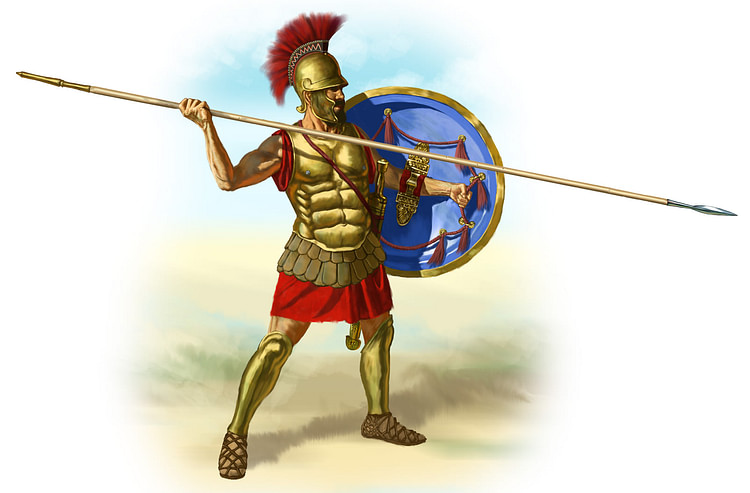
The Greeks were actually quite brilliant in their choice of warfare style.  They had an entire group of infantry, the hoplite, who were the core of the armies.  The hoplite gained its name from a word for armor, hoplon, which is often used to describe the soldier's most obvious piece of armor: the shield.  Now, as I'd mentioned in previous posting, the shield is what this all focuses on.  If you've seen 300 (which I have numerous mixed feelings regarding), and recall Ephialtes's attempt to join the Spartans, you may see their logic.  The core of the fight for the Greeks was the shield wall.  If a soldier could not bear a shield properly, there was a weak point in the wall, and a breakthrough may be exploited.

Essentially, the phalanx with its shields was a mobile fortress.  When their men would go off to war, the wives and mothers of Spartans would tell them "With it or on it." (Ἢ τὰν ἢ ἐπὶ τᾶς, pronounced "ae taan ae epi taas")  Fighting without a shield was impossible.  Retreating and discarding your shield was unthinkable, and the hight of cowardice.

The individual hoplite did have armor.  Breastplate and helmet were frequent, with arm and leg armor being occasional, from what I can gather.  These were expensive pieces of kit, and often passed down from father to son.  Leather or linen were cheaper, and used by poorer soldiers, who functioned as skirmishers and scouts.  But at the end of the day, the shield was the chief defense.

The Greeks preferred spears as the main weapon.  The doru spear was over eight feet long, allowing them to reach an incoming enemy long before the charge reached the shield wall.  Later Alexander's army would use the sarissa, which was over 14 feet long.  However, unlike the sarissa, the doru wasn't just an emplacement pole arm.  It was used one handed and thrusted.  But St. Paul doesn't mention a spear, and we'll look at why I think he didn't later.

The end result of the nearly 3000 year history of the Greeks was a military style that would be immensely successful until being adopted, adapted, and superseded by the Romans.  And that is for next time.

Friday, October 27, 2017

Heresy Reporting Names Master List

Taking up the Sword is a dangerous task.  The art requires a studious mind, and a willingness to accept the proper authority.  When people have tried to "use their own ideas" to interpret Scripture things have gone wrong.

That is how heresies are born.

The early Church dealt with a lot of heresies.  A teacher could simply show up, claim to have some sort of knowledge about the Bible that brought him to the understanding that, for example, God is really a eight foot tall purple giraffe.  Other teachers, though, would check Scripture and call this false teacher out.  Everyone realized pretty quickly that there needed to be a universal answer, so councils would form to deal with hot-button issues.  These ecumenical councils are key in the formation of the Christian Church in the first thousand years.

Now, not all things called heretical are heresy, and not everything accepted as Christian is sound Scripturally.  So, lets first define a heresy.

Thomas Aquinas defined a heresy "as a species of infidelity in men who, having professed the faith of Christ, corrupt its dogmas."  (Now, I'm not always in agreement with Aquinas, but he was a doctor of the church, and this definition is a solid one.)

To be more modern in our understanding, a heresy is a teaching that looks Christian on the outside but has none of the foundation.  One of the most well known is Arianism, which taught that Jesus wasn't divine but a creation of God the Father.  It's the poster child of heresies mostly due to the Nicene and Athenasian Creeds, which means almost every Christian has heard it or its teachings refuted.

The frustrating part of heresies today is the Protestant Reformation.  Now, protestantism is listed as a heresy by the Roman Catholic Church, and condemned at the Council of Trent (1545-1563).  While heresies are to be condemned at ecumenical councils, the meeting at Trent was not ecumenical, that is, the whole church.  It was only the RCC calling out opposition, some of whom were merely schismatic not heretical.  Some "reformers" did adopt heretical views (and we will, in time, be taking pot shots at them), but some did truly want to discuss issues that were leading people astray.  Ironically, this means sections of the Roman Church may be labeled "heretical," though heterodox (doctrines that are non-conformal to official teachings) may be more accurate.

My intent is to call out the ones that are prevalent today, kind of a "target recognition" list.  Below is a list of heresies condemned as of the Council of Chalcedon in 1054, with notes about their beliefs.

First are the Trinitarian heresies.  All of these deny the Trinity, but often in specific ways.

Adoptionism
- Belief that Jesus was born a mere human, later adopted as "Son of God" at baptism
- Denied Christ is fully God
Apollinarism
- Jesus had a human body, and a "lower soul" (seat of emotions), but a divine mind
- Denied the divinity of Christ
- Denied the Two Natures of Christ
Arabici
- Belief that the soul perishes with the body at death
Arianism
- Belief that Jesus was created by God
- Denied the divinity of Christ
Docetism
- Belief that Jesus didn't have a physical body, but that His body and death on the cross were illusions
- Denied the humanity of Christ
Macedonians / Pneumatomachians
- Belief that the Holy Spirit is a creation, and servant, of God the Father and God the Son
- Denied the Holy Spirit is God
Melchisedechians
- Belief that priest Mechisedech is incarnation of "logos" (divine word) and the Holy Spirit
- Denied the Holy Spirit is God
- Denied Christ is the Word of God
Monarchianism
- Overemphasis on "invisibility" of God
- Leads to Adoptionism or Modalism (Sabelianism)
Monophysitism / Eutychianism
- Belief that Jesus's divine nature overwhelms His human one
- Denied the humanity of Christ
- Denied the Two Natures of Christ
Monothelitism
- Belief that Christ has two natures, but one will
- Denied the humanity of Christ
- Denied the divinity of Christ
- Denied the Two Natures of Christ
Nestorianism
- Belief that Christ was a natural union between Word and Flesh, not the divine Son of God
- Denied the divinity of Christ
Patripassiansim
- Belief that Father and Son are not distinct persons, and that both suffered on the cross
- Denied the individuality of the Trinity
Psilanthropism
- Belief that Jesus was never divine
- Denied the divinity of Christ
Sabelianism (more commonly called Modalism)
- Belief that the Father, the Son, and the Holy Spirit are aspects of God, not distinct persons
- Denied the unity of the Trinity
- Denied the individuality of the Trinity

Next up are the Gnostic heresies.

Gnosticism, and its heresies, are a sticky wicket at times.  The various philosophies that lead to and contribute to gnosticism predate Christ's death.  There are many variations of gnosticism.  The most commonly held belief is the teaching that humans are divine souls trapped in a material world created by an imperfect god.  The gnostics taught that a "secret knowledge" was needed to transcend this imprisonment.  A lot of philosophies, Buddhism being most obvious, teach this.  In some ways, gnosticism is synonymous with mysticism, but not universally, especially since neither are so easy to nail down.  To make matters worse, when a theologian speaks of gnosticism, usually he speaks of the Christian sects and cults that are heretical, not the other ideas that could be called gnostic.  This just adds to the confusion brought about by false teachers like Bart Erhman.  Guys like him believe, quite wrongly, that the "gnostic gospels" are older and more accurate than the New Testament.  The sensational nature of such "research," coupled with books like "The da Vinci Code," have made gnosticism quite popular to consider as an "explanation" for Christianity.  I will have to deal further with Erhman and others at a different time, since refuting them is easy but somewhat lengthy.  Right now, lets just list the gnostic heresies.

Manichaeism
- Belief that good and evil are equally powerful, with evil being the material world
- Denied the Creation account
- Denies the humanity of Christ
Paulicianism, Priscillianism, Naassenes, Valentianism
- Dualistic gnostic sects
Sethian
- Belief that the serpent in the Garden of Eden was an agent of the true god to bring knowledge
- Denied Original Sin
- Denied the Fall
Ophites
- Belief that the serpent was the hero and god the villain
- Denied Original Sin
- Denied the Fall

Finally there are other early heresies that don't quite fit into these two categories.  The ones that have stuck around today most frequently are one of these.  They include:

Antinomianism
- Belief that Christians are free from the moral law
- Denied Original Sin
Audianism
- Belief that God literally has a human form, and Jesus death to be celebrated during Passover
Barallot
- Held all things, including wive and children, in common
Circumcellians
- Militant version of Donatists, who would attack people to provoke being "martyred"
Donatism* (may be a schism, not heresy)
- Taught that ministers had to be faultless so as to have the sacraments administered by them to be valid (initially as a reaction to those who betrayed the faith in the face of Roman persecution)
Ebionites
- Belief that Christians must follow Jewish laws and rites, and that Christ is not divine
- Denied the divinity of Christ
Euchites / Messalians
- Belief, among other things, that a state of perfection is achievable through prayer not sacrament
Iconoclasm
- Belief that icons were idols and should be destroyed
Marcionism
- Belief that Jesus was God and Paul the chief apostle, but the Hebrew God was separate and lower
- Denied the Trinity
- Somewhat overlapping with Gnosticism
Montanism
- Belief that new prophecy overrode apostles, that falling Christians could not be redeemed, that ecstatic prophecy was required
Pelagianism
- Belief that humanity wasn't tainted by original sin, and the human will can choose good or evil
- Denial of Original Sin
Semi-pelagianism
- Belief that the growing of faith was by God's grace while beginning of faith was man's will
- May be synonymous with Arminianism
- Denial of Original Sin

Of all of these, some are more prevalent than others.  Iconoclasm was a big issue in the Middle Ages, and at times is today (thanks to John Calvin).  Pelagianism and Semi-Pelagianism are rampant, as is Arianism, Modalism, and Antinomianism.  A number of teachers may have incorporated Gnostic teachings as well, and the ideas of the Ebionites are very popular with the "Hebrew Roots" movement, if I'm understanding that kerfuffle correctly.

Now, I know the title says this is a "master list," but to be honest its not.  There are more, and I'll probably have to amend it as I encounter.  But that's not the point.  The goal here is to write up little reports on what various heresies are and how to recognize them.  Much like how fighter pilots are trained to recognize different aircraft and know how best to deal with them.

So that will be the next task: detailing a specific heresy and how it occurs today, as well as documenting the countermoves.

Wednesday, October 25, 2017

Step Into The Forge And Suit (Of Armor) Up! (or) Ready To Raid An Archive, Young Hoplite?

Its time.

For a while now I've been thinking about some sort of "fight book" about apologetics, the Armor of God, and such.  But, I'll start with some primer work, and a sort of "test run" as I fiddle with ideas.

First, the text:
Finally, be strong in the Lord and in the strength of his might.  Put on the whole armor of God, that you may be able to stand against the schemes of the devil.  For we do not wrestle against flesh and blood, but against the rulers, against the authorities, against the cosmic powers over this present darkness, against the spiritual forces of evil in the heavenly places.  Therefore take up the whole armor of God, that you may be able to withstand in the evil day, and having done all, to stand firm.  Stand therefore, having fastened on the belt of truth, and having put on the breastplate of righteousness, and, as shoes for your feet, having put on the readiness given by the gospel of peace.  In all circumstances take up the shield of faith, with which you can extinguish all the flaming darts of the evil one; and take the helmet of salvation, and the sword of the Spirit, which is the word of God, praying at all times in the Spirit, with all prayer and supplication. To that end keep alert with all perseverance, making supplication for all the saints, and also for me, that words may be given to me in opening my mouth boldly to proclaim the mystery of the gospel, for which I am an ambassador in chains, that I may declare it boldly, as I ought to speak.  Eph 6:10-20 (ESV)
While I trip through all of this I will be using St. Paul's metaphor as a springboard.  As always, what you read here is for consideration.  It's not "thus saith the Lord."  Rather, "thus saith Adam."

Remember the three rules of Biblical exegesis: Context; Context; Context.

So, how about some context.  Since the vast majority of us live in the modern world, suits of armor haven't existed for the better part of half a millennia.  Even the concept of a knight doesn't really exist anymore.  Except it does.  And armor does.

But, then again, the knight in shining armor isn't what Paul meant, since the concept as we think of it didn't exist yet for him.

So lets tip toe through the archives.  Up for it?

Who am I kidding, of course you are!  Bear with me, since we'll be having to start with some straight-up history.  (Yay!)

Armor has been used in warfare since someone figured out "if I wear this stuff, then those guys can't go stabbity stab stab on me."  It started with things like plates riveted or tied to cloaks, links of mail, treated leather, and even thick cloth.  The Greeks were among the earliest to start using metal as armor, at least in the West, so we'll start there.
(The Hoplite, in Spartan livery.)

The "average citizen" Greek soldier didn't have armor, just shield, maybe helmet, and weapons.  A lot of times these guys didn't stand in the phalanx, though.  The hoplites were the phalanx, and they had armor.  The armor (Greek word is panoply) of a hoplite weighed about 70 pounds.  The richest (middle class on up, that is) could afford bronze breastplates, though leather or linthorax (linen strip based, kinda like kevlar) was common.  Corinthian and Chalcidian helmet styles were the stereotype.  But we'll get to the Greeks in greater detail later (maybe, depending on how far I take this).

Lets move on to the guys who one-upped the Greeks.
("We. Are. The. Legion.")

The soldiers of Rome had a very sophisticated kit.  Heavily influenced by the Greeks, and by the army of Alexander the Great.  The Legions were the logical conclusion of a few millennia of city-state conflicts and near East imperial wars.

The Romans, at various times, used plate armor, segmented armor (lorica segmentata, the stereotype), scale armor, and mail.  Each had advantages, and disadvantages; were better for one type of combat or another; were easier to make or less expensive.

But it wasn't just the armor they wore, the legionnaire had substantial equipment and weapons.  Their shields were what made the phalanx a force to be reckoned with.  The weapons as well.  Spears for throwing, or for use in the line.  Short swords were the back-up weapon.  Think like how the average modern soldier carries a rifle (the hasta) and a sidearm (the spatha).  But, like the Greeks, we'll dig more into the Romans later, since they, and the Greeks, inspired the metaphor.

Moving onward in time, the Middle Ages, while rife with many types of warrior, was the era of armor warfare.
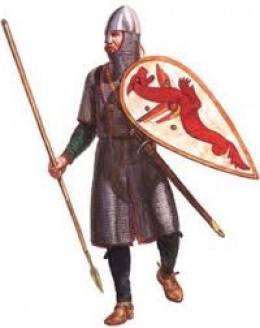
(The foundational Carolingian or Norman soldier of the 6th-9th century.)

(The classic Crusader of the 11th-13th century.  A Hospitaller, most likely.)

(The sophisticated knightly armor of the 14th-15th century.  A pinnacle of Medieval technology.)

Archers, pike-men, skirmishers, knights, templars, paladins, crusaders, jaegers, vikings.  If they could make a cameo in a Tolkien style work, they are here.  Warfare made substantial changes from the 5th century through the Renaissance.

Armor and weapons became more sophisticated, and costly.  Training was a necessity for all soldiers, not just the elite upperclass.  Conflicts grew from a couple of feudal lords arguing to full on nation verses nation.  If you want, there are plenty of resources on that era, but British presenter and historian Mike Loades has some of the best on the Medieval period, I think.  Check out some of his work here, here, and here.

When we hear "Armor of God," we think of either the crusader or the "knight classic."
(Ah, how I love the classics...)

It makes sense to use this as the "jumping off" point for, not only St. Paul's metaphor, but my tangents on it.  Especially since I'm hoping to stylize it like a Medieval manual on melee and martial matters.  And I will, in time, once I set us up correctly.  But bear with me a little bit longer, since to be able to backtrack to the proper "headspace," we need to examine the full history.

The introduction of firearms sparked the decline of armor.  But what really spelled the end of the classic era was national identity.  If the people were loyal to a nation, not a local lord or state, then they could build a larger power base than just a few dozen square miles.  Soon conflicts between kingdoms, nations, and empire were the norm.  Wars that lasted for a few years, and had fighting for most of that time.

For example, the Hundred Years War lasted just over 103 years, yet the total time of direct army-verses-army conflict was about three months.  Sure there were raids and skirmishes here and there, but the times when full-fledged armies lined up to do battle were rare.  That was the norm until the late Middle Ages.  At that point you have kingdoms and empires, like France and England, seeking greater influence than just their little corner.  The Age of Discover kicked off a paradigm shift.

This was across the board a good thing, don't get me wrong, but with tech advancing rapidly, new warfare styles arose.  The musket replaced the spear and bow.  The rapier replaced the longsword and shield, before the sword was dropped altogether.  It was less expensive, and more effective, to train a platoon of musketeers than equip and train a half-dozen knights.  Dragoons, uhlans, and hussars were better cavalrymen for this new warfare than knights, anyway.  Ships became actual weapons of war.  Cannon beat the trebuchet.  Mobile formation warfare was the tactic of choice from around the 15th century through the American Civil War in the late 19th century.

With the new emphasis in mobility and speed, armor was dropped.  Slowly at first.  Pieces dropped to aid in gaining speed or mobility.  Shields became smaller.  Helmets cut to give more visibility.  Soon the only armor seen was the curriass and helmets.  This combination never went away fully, though the vast majority of armor worn by soldiers from about 1700 through 1990 was just the helmet.

Specialized armor was available for certain situations.  Flak jackets for bomber gunners.  Padded suits for bomb-disposal techs.  Heavy cavalry still wore the breastplates through 1919.  And now personal armor is making a comeback, though protection from shrapnel is the main goal, and advanced cloths and plastics are the materials.

But the replacements for the soldier that started as the hoplite, became the legionnaire, then morphed into the knight are the fighter plane and the tank.  Neither of which work in this metaphor, though, neither does the modern soldier.

Why?  Too much kit.

You see, the soldier that St. Paul described wasn't a "heavy infantryman," but a "skirmisher."  A scout.  A messenger.  Someone tasked with running from the battlefield to proclaim "we have won."  (Passing out and dying after sprinting 26.1 miles in full armor optional.)

I'll explain more of what I mean once I dissect the Greco-Roman style of soldier.

Hopefully I'll get other aspects of this ironed out.  For example, I've been playing around with a "recognition card" for heresies, like how AA gunners would have "spotter cards" with aircraft silhouettes.  But, this is all a long term project, and likely to be disjointed and revisionist as I move onward and learn more.  Same with the whole armor motif I'm playing with.  Maybe I'll stick traditionally, or go back in time to the Greco-Roman version, or something completely different.  Whatever the case, hopefully you enjoy my efforts (even if I'm just flailing about in the dark) and learn something useful.

Monday, October 23, 2017

Classic Curves Beat Modern Angles (or) Newer Doesn't Mean Better

"She may not look like much, but she's got it where it counts."

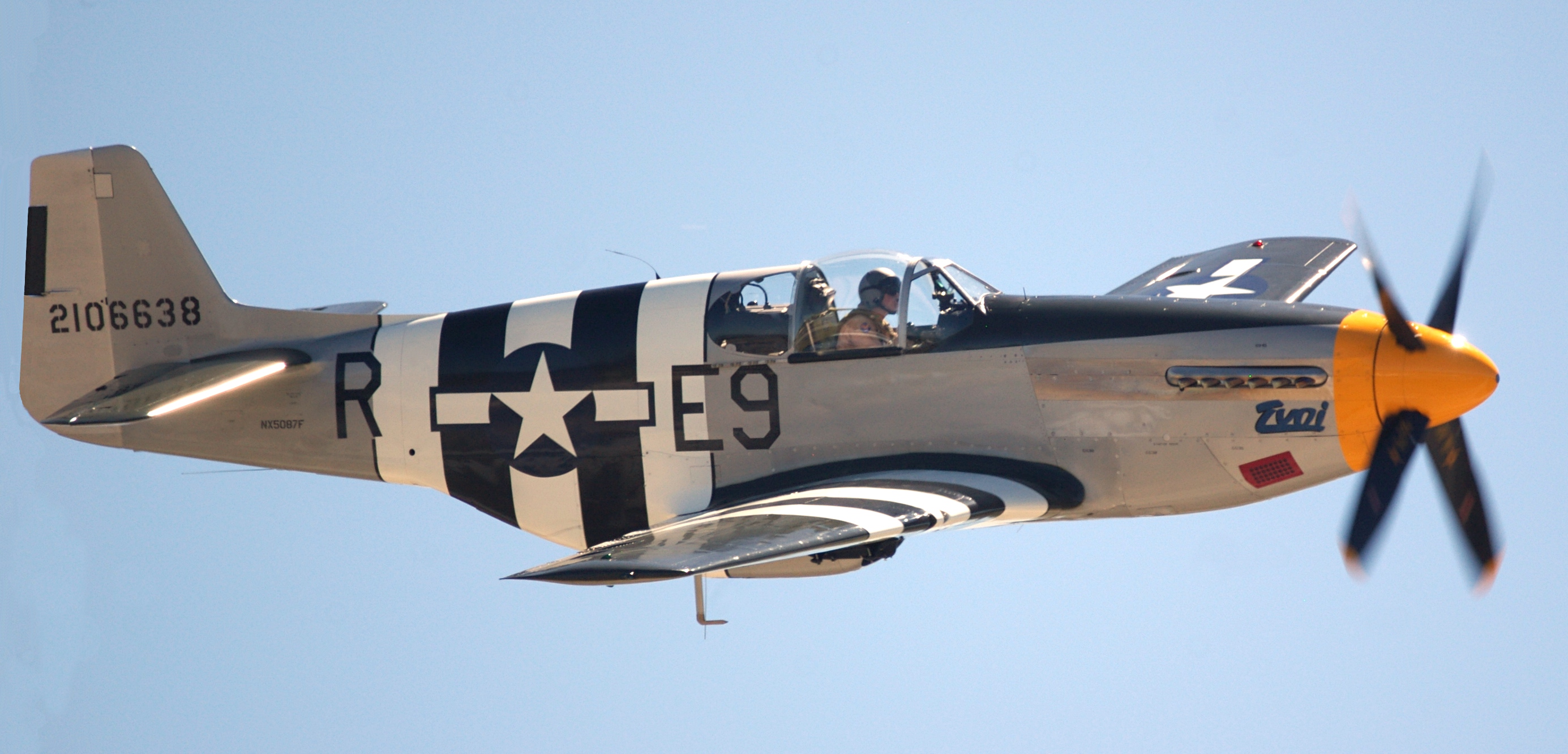
Ah, the North American P-51 Mustang.  The poster child of World War 2 fighter aviation (deservedly).  The favorite of armchair aces nationwide.  But why?

(Hard to say no to a red-tail.)

To be honest, a more than decent chunk of the Mustang's popularity is thanks to the car.  Ford wisely chose to name their sporty teenage dream car after the "cool plane dad flew during the War."  Because of that, the name is one everyone recognizes, whether they are a history buff or not.

The Mustang is one of the few aircraft from WW2 that the average person knows (along with B-17, Spitfire, and Zero).  And this is for good reason.  The Mustang flew in Europe (bigger civilian population), where its primary role was escorting bombers and providing close air support for troops (lots of guys seeing them in action).  And with the polished bare metal they wore in the last years of the war, the P-51 was the knight in shining armor, doing battle against evil.  A slick, curvy sportster with flashing paint.

But this classic wasn't an instant success.  And if you know anything about me, its that I like to wander through the history and details of something.

The powerhouse that became the P-51D Mustang began life as a request from the British for the North American Aviation company of Inglewood, CA, to build P-40 Hawks.

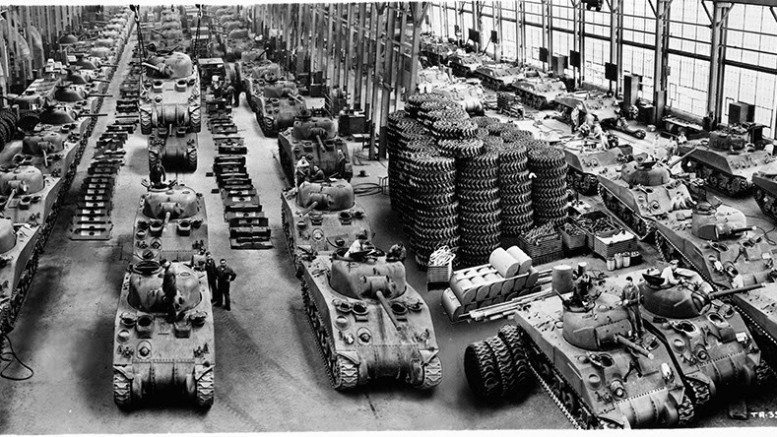
The date was 1940.  Britain was desperate for military equipment.  Thousands of small arms were abandoned in the escape at Dunkirk.  Hundreds of aircraft were destroyed in the Battle of Britain.  Uncountable tons of shipping were lost to the U-Boats.  The British were hurting for everything from rifles to boots and tanks to morphine.

And the United States had the industrial muscle to provide.

(Looks like we're gonna have a bumper crop of Shermans this year.)

So the British Purchasing Commission went about looking for equipment.  Aircraft specifically, of all types.  While the US had bomber, patrol, and cargo aircraft that met or exceeded needs, America's available fighter choices were not quite up to par.  The P-38 Lightning was too complex with its turbochargers.  The P-39 did not have the reliability of engine, main gun, or flight characteristics.  (At least, not in the style of fight used in Europe.  She did well to exceptional in other theaters.)  The only remaining choice to replace the lost Spitfires and Hurricanes wast the P-40.  And she wasn't good enough.  But she could be built fast.

Now, the P-40 isn't a bad plane, even when compared with the Bf 109 and Spitfire.  In 1940 she was just a hair faster a low level, and could turn better than the 109 at most altitudes.  Her armament was on average better than theirs, with the new P-40E having six machine guns.  The B/C model wasn't half bad, either, though didn't quite have the punch or acceleration.  And the upcoming F model would have a Rolls-Royce, putting her more on par with the European types.  The problem was two-fold.

One, its gonna take a while to get enough RR Merlin engines, since the factories in England were at capacity and all the engines were needed already, and the Packard factory in the US would take time to get up to speed making them.

The P-40 had a good engine already, the Allison V-1710.  The problem is the Allison isn't as good above 20,000 feet compared to the Merlin or the German DB 601.

And fighting over Europe tended to take place above 20,000 feet.

The second problem was Curtiss.  Their factories were already at capacity building P-40s (for the US), C-46 Commandos, and a handful of Navy scout and bomber types.  They were running full tilt just to fill the orders from the US, British, French, and Russians already.  Taking on more wasn't physically possible.

The solution was simple: the British wanted North American Aviation (NAA) to build P-40s under license.  They needed planes, any planes, and the P-40 was competent.  It could be used to free up Spitfires for the higher up work, and its range and ruggedness meant it could do attack work.  And they were more at home in the far-flung theaters than the Spitfire.

But NAA had a counter proposal: they could build a better plane with the same engine quicker than it would take to set up the assembly line for the P-40.  With nothing to lose, the Brits took the bet.

In September of 1940, a mere 102 days after the British approached them, NAA rolled out NA-73X, the prototype.

(The NA-73X - where it all began.)

Slick, curvy, and ready.  Other than a few tweaks that would come from testing, she was ready.  And, in British tradition, the fighter received a name, rather than a numerical designation.  The name they chose was taken from American heritage: Mustang.  A wild, untamed horse.  Perfect name for a fighter.

The Mustang I and Ia were the first ones, improvements on NA-73X.  They looked very similar, too.  The carburetor scoop was longer, the radiator intake a little different in shape and size (to better use the Meredith Effect), and the canopy was less racer style.  Being powered by an un-turbocharged Allison, the Mustang I was used at low levels, with recon being a primary role.  At this point, the US wasn't yet interested in the plane, but that would change after the attack on Pearl Harbor.

The Army Air Corps called the plane the P-51, with the nickname "Apache" being attached.  Like the Brits, the US put the P-51 in as a lower level fighter and recon bird.  A good role; a needed role.  Especially in areas like Southeast Asia and the Mediterranean.  The follow-on P-51A (Mustang II to the Brits) had improved armaments, switching from four .50s and four .30s (with two .50s in the nose and the rest in the wings) to four .50s in the wings.  A few of these early Mustangs were armed with four 20 mm cannon, but they were specifically the recon version.

(The P-51A: in my opinion the prettiest Mustang.  Ever.)

The Army Air Corps/Force even took some and made some of them into dive bombers.  A little envious, perhaps, of the Stuka?  The A-36A Apache was a decent attacker, but was better as a fighter.  Go figure.

Neither the Brits nor the Americans were happy with the lackluster performance of the Allison at altitude.  So they fitted a few with Merlins, which led to the P-51B/Mustang III.  A few other mods went in, like a redesigned radiator.

What resulted was a war-winner.

(If I had to be a Mustang pilot over Europe, this is the one I'd want.)

She had the range, the speed, the altitude, the firepower.  Every box that needs to be checked on a "best fighter checklist" she checked.  (And yet I still put the F4U as better, but I already explained why.)  The "B" was the best Mustang.

Now, a few of you who are aviation buffs are possibly shouting at your computer screen: "What about the D, you muppet!  The D was the ultimate Mustang!  Thousands were build, all the aces flew them!  Aaargh!"

Yeah, yeah, whatever.  The "B" was better than the "D" in most ways, and I'll get to that, but first, the quirks both marks shared.

Trading out a better engine in a Mustang (car) is easy.  Trading out a better engine in a Mustang (plane) really goofs stuff up.  Stability.  Thats why a strake or fillet was added to the stabilizer with most of the "Ds" and retrofitted to many "Bs" and "Ds."

(Notice the difference between with and without the fin.)

Apparently, trading out a different shaped engine messed with the stability of the plane, so a relatively simple fix was made.  This was easier than other issues, at least.

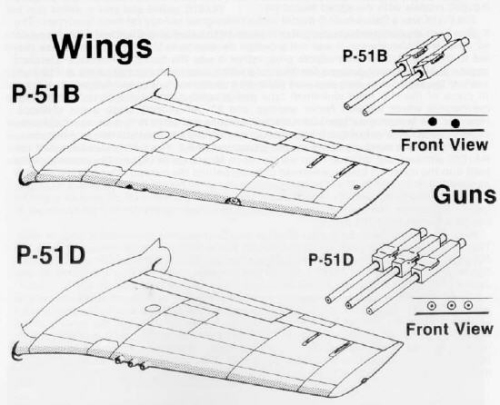
One of the few drawbacks of the "B" was the wing.  You see, NAA used a slick, thin wing to improve speed.  Unfortunately, that meant less space in the wing for the guns, so, to make sure everything fit, they were put in at an angle.


This lead to jamming, thanks to the ammo belts being kinked a little.  Simply uprighting the guns wasn't that easy, since the wing was thin.  So on the "D" a thicker wing was installed.  While this meant the guns had more space (allowing less jamming, and an additional gun), it did mean a slight loss of speed and agility.  And, more ammo wasn't added.  So, same number of bullets for 50% more guns means less time to shoot.

In an attempt to improve visibility, the "D" was given a teardrop "bubble" canopy.  The Brits had been working with frameless canopies on a few planes, like the Typhoon, and even the Spitfire.  But, to accommodate that on the P-51 required trimming down the back half of the body.  That contributed to the instability fixed by the added fin.  The new canopy did improve visibility upward, compared to the previous clamshell type framework, but it wasn't the best.  The few "Bs" modified with Malcom hoods (which look like fishbowls) were better.  They could see behind as well, and, due to the "bulging out" had a little visibility downward.

But the biggest quirk that the "D" had, which makes the "B" better, was the fuselage.  By cutting down the turtledeck, the "D" lost capacity in its main tank, thus reducing range.  Not that the "D" didn't still have gobs of range, especially with the external tanks.

In fact, that is what made the Mustang a war-winner.  Not her speed or handling, but her "seven league boots," allowing the Mustang to escort bombers from England all the way to Berlin and back.  All Mustangs had that phenomenal range.  Some Mustangs were used late war escort over Japan, flying round-trip missions of nearly 10 hours.  It lead to an interesting role reversal, with a single B-29 escorting a squadron of Mustangs on a fighter sweep, since the bomber had the navigation equipment for long overwater flights.

Did you know that early Mustangs were occasionally shot down by Allied gunners?  Why?  Because from certain angles she looks a bit like the Messerschmitt.  That's why a lot of Mustangs, especially early on, had yellow stripes on the wings, and why they painted such bright colors on the nose and tail.  The more you know.

Now, this has been a really long wander about a plane that isn't in my "Top 5."  But its hard not to like the old bird.  A classic that's still making a good performance at airshows and races worldwide.  I just wish there were a few more "A" and "B" models in flying condition.

(See what I did there, DAR?)

Where Have All The Baby Clothes Gone? (or) Which Is It, Only Two Or More Than Two?

Since there's a new squirrel being added to our rave*, Meg and I were wondering about the baby section at the store, looking at clothes, when I realized something.  The only baby clothing available is gender specific.

So, in spite of all this talk about how gender is a social construct, and there are more than two genders, and assuming someone's gender is some sort of abuse, the fashion industry has stubbornly adhered to the idea that there is "boy" or "girl" as the only two options.


(shrug) I know, that was my thought too.  The fashion industry, supporting the concept of only two genders.  Who'd'a thunk?

Now off to scour the interwebbings to try to locate Fanta, a kangaroo, and more ridiculous gifs for use here and elsewhere.  Because I can.


*As for the previous joke, I stole it from here:


Those of you who are parents or preschool teachers will understand the joke.  Everyone else probably won't understand the "adding" part, unless they remember I mentioned last month that we're waiting for Kiddo #4.

Sunday, October 22, 2017

Some Rules Are Meant To Be Broken (or) This Title Is Also A Title Drop

If you've examined the side bar of this blog, it should be no surprise I am a fan of Rev. Jonathan Fisk's work.  His book "Broken: 7 'Christian' Rules That Every Christian Ought To Break As Often As Possible" is a great resource.

I bring this up because, as I was talking with myself the other morning (as I often do), I realized that the modern infatuation with sciences as the answer to every question in life is just a pathetic rehash of revolutionary France's attempt to make reason into a goddess to replace Jesus.

Search your feelings (and the historic records).  You know this to be true.

Anyway, I realized that Fisk already wrote about this.  So, since I'm trying to write a "fight book" for Christians, centered around the concept of the Armor of God, I thought I'd start playing with it here.  (And, to be clear, when I say "fight book," I'm taking stylistic inspiration from Hans Talhoffer.  Check it out here.)

The "rules" (or, potentially, false religions) that Fisk notes are:
  1. Mysticism - the notion that “you can find God in your heart.”
  2. Moralism - the notion that “you can find God in your hands.”
  3. Rationalism - the notion that “you can find God with your mind.”
  4. Prosperity - the notion that “you can find God in money/stuff/the world.”
  5. IfWeCanJust... (Church-ology) - the notion that “you can find God in spirituality.”
  6. Freedom - the notion that “you can find God in God’s absence.”
  7. Counterfeit Christianity - the notion that “you can find/be God.”
So, since I want to write a resource for the one who wears the armor of God (a "knight" perhaps), how about some identifying of these seven counterfeits while I play around with this in my head.

#1 "Mysticism"
Oh, that's easy.  Its everywhere, often summed up with the advice of "follow your heart."  This where people who say "I'm not religious, I'm just spiritual" are.

#2 "Moralism"
These are people who are "righteous" based on their actions.  Frm. Pres. Carter and his rational for building houses is based on this.  This is "faith by works" territory.

#3 "Rationalism"
Science!  I said "science!" again!  "Thinkers" who use reason and logic as their foundation for everything are rationalists.  It can very quickly end up as a depressing stance.

Please note, Rationalism has a soldier named Pragmatism, and Rationalism and Mysticism have a bastard son named Education. (I hope I remembered that correctly.  I don't have the book on hand right now.  Mom's borrowing it.  Not that any of you needed to know that.)

#4 "Prosperity"
Just repeat what Mr. Shiny Teeth says "This is my..."  Or just think like Gordon Gekko.  If you believe that how well off you are in life is directly connected to your faith, well, I got bad news for you.

#5 "IfWeCanJust..."
While I stated earlier that the "not religious/just spiritual" crowd hangs out in mysticism, this is there bread and butter.  Or cracker and mustard.  "Charismatic" churches are solidly here.  They live and die based on how "spiritual" they are.  Pirate Christian Radio deals with these guys.

#6 "Freedom"
Americans love this one.  You can call this antinomianism (no-law-ism) or atheism.  Either way, the person here is claiming that they are the arbiter of truth and there is no one in higher authority.

#7 "Counterfeit"
If you are using anything other than Scripture Alone to build your faith, then you have taken hold of the forbidden fruit, believed the lies of the Devil, and swallowed it hook, line, and sinker.

If you want more, check out Rev. Fisk's book.  You can get it here or here.  I'll get back to this once I have something more coherent regarding the metaphorical "Christian knighthood."

Friday, October 20, 2017

Sacre Bleu! (or) Never Go Against A Sicilian When Dinner Is On The Line

French holds the claim to being the stereotypical "language of love."  After all, it is one of the Romance Languages.  And does anything sound prettier than French?

(And, no, shouting I love you in German doesn't count, though the point of that joke is true.)

(Did you know achtung! means "good morning?)

But is French really the language of love?

No.  Italian is.

Consider: "the way to a man's heart is through his stomach."  (Gentlemen, please "Home Improvement grunt" if you agree.)  However, French food is not the best food.  Rather, Italian is more universally preferred.  Don't believe me?

Without using the internet, name five Italian dished in ten seconds.

Now, try to name five French dishes.

Can't do it.  Its not that French food isn't good, just Italian is superior.  So, Italian is the "food of love."  Still don't believe me?

(Would Disney lie to you?)

So, if Italian is the Food of Love, and food is a universal language, then it stands to reason that Italian is the Language of Love.

(And thanks to Fanta, German may be the language of refreshing.)