Monday, March 17, 2014

Erin go bragh!

(That means "Ireland forever!")

Happy St. Patrick's Day!

For those of you who don't know, I am, ashamedly, mostly not-Irish. I know, how dare I not be. Instead I ended up as a mix of mostly German and Italian. But there is some Irish blood in me. That means that I am very precise and efficient (German), tomorrow (Italian), and how dare you call me lazy (Irish)!

I don't really have anything specific to say today, I guess. Except that the story of St. Patrick is much more interesting than green colored beer.

Patrick was born in England around AD 385. Just so there is no doubt, here's why that's is significant. The Council of Nicaea, where the church sat down and composed the creed, was only 60 years earlier. The church had only recently found favor with the Roman Empire. Our faith community was still young and "untested." We were going through growing pains. Christianity was new. Radical.

Patrick was born in what was the Roman equivalent of the "wild west." To the east was Scandinavia with its pagans, who would soon become the Vikings. To the southeast was Germany, with the original "barbarians." To the north, a cold sea of ice. And to the west, a land of green hills and tenacious people. The locals called it Eire.

Ireland.

As far as we know, Patrick was the son of a deacon and grandson of a priest. (Yep, at this time there was still not an "official" stance on priestly marriage. Or at least not a well enforced one. I'm still looking into it. Early Church history is fascinating!) Anyway, Patrick, like any pastor's kid, was not a "devout" Christian growing up. Then, when he was sixteen, pirates kidnapped him. (Robert Lewis Stevenson, where are you?) They sold him as a slave in Ireland, where he served for six years.

While as a slave, Patrick fell back on his faith, especially prayer.  After six years, he felt lead by God to leave Ireland.  Somehow he convinced a ship to take him home. Once back in England, he joined the church and began studying the Word. He felt called to be a missionary to Ireland.

Now, remember. Ireland is where he was a slave. And the Irish are not known for being the most friendly to people who invade their nation (though, no one is). This little island is one of the extreme points of the known world at the time. As far a Patrick knows, you cannot go any farther west.

Patrick had his work cut out for him. It wasn't like Ireland today. Their religion was a form of paganism, led by druids. Since none of them wrote anything down, we're not entirely sure what their religion was about. Not that it matters too much. What we do know are the stories that have survived. Patrick chose to preach in a place with a mythology as rich and diverse as Greece or Egypt. But he had an advantage.

Remember I mentioned the Council of Nicaea? Yeah, Patrick heard about it. Especially the parts where they talked about the Trinity. Bet you know where this is going. Its a well known story Patrick using the shamrock to explain the Trinity. But, like I said, he had an advantage. You see, Irish mythology had something that most religions did not have: a tipple deity. Three goddesses, Brigid, Eriu, and the Morrigan, were not simply one person, but three. Not simultaneously, but still, three distinct persons. So teaching the Irish that God is really three persons in one was not so much of a shock for them.

Isn't it funny how God works sometimes? Sets the foundation for a lesson generations in advance, and only in hindsight do we see it clearly.

Oh, well, I've had my ramble. If you want to know more about St. Patrick, there's a lot available, but much of it is a bit of conjecture and assumption, since we don't have official date and documents and such. And if you want something kind of silly and great for the kids, Veggie Tales made a version of his story. Its a short on one of their videos: "The Sumo of the Opera." Its also on "Tales From the Sock Drawer."  It is both fun and accurate.

I'll leave you with this final thought:
May God be with you and bless you. May you see your children's children. May you be poor in misfortunes and rich in blessings. May you know nothing but happiness from this day forward.

Thursday, March 13, 2014

When Being Banished Is A Good Thing

One of the first things we learn in Bible class is the difference between Law and Gospel.  The basics are in their names: Law is rules, Gospel is good news.  Now, where in the Bible is the first example of Law and Gospel?

Most people can easily figure out that finding Law is easy.  Simply look for rules that God gave us.  Gospel seems more challenging, but it isn't.  Many think that we don't see Gospel until the New Testament.  "The Old Testament is Law, and the New Testament is Gospel."

But is it that clear cut?

No.  The entire Bible is Law and Gospel.  That's how it works.  You cannot have the joy of Gospel without the realization that we cannot live up to the Law.

It can be argued that the first Law occurs shortly after the first Gospel.  Hold up!  Am I seriously saying that the Gospel came first?  But doesn't it work the other way around?  Didn't I just say that you need Law telling you how much you suck to know the Gospel of how much God loves you?

This may seem like a bit of chicken-egg controversy, but hear me out.  In Genesis 3 we read about the Fall of Man.  In that chapter is a lot of important stuff, so I'll take us through it first, then explain why I think Gospel came first.

The first character in this drama is Satan, the serpent.  And what is the first thing he says?  A lie?  No.  The first thing he does is ask a question.  Remember, all good liars use this method: Question, Half-truth, Unfulfillable Promise.  So he asked "did God really tell you that?"

And who does he ask?  Eve.  The reason why is simple.  Eve is the "younger" of the two first people, and was not as aware, I guess we could say, of what the exact rule or reason for God's instructions were.  Adam told her, no doubt, but when put on the spot, her memory falters a bit.  She explains it correctly, but adds too much.  Maybe God said "just to be safe, don't even touch the tree."  But, using child-like logic, Eve connects "don't eat" with "you're gonna die."

Satan follow this question with his half-truth and promise together.  "You will not die."  Well, technically we won't die.  We have an eternal soul, which will live forever.  And we won't die immediately, it will take time.  He then promises that we will be "like God."  Again, technically, we are like God, but in a different way.  Before the Fall, we were more like God, since we were perfect and sinless.  After the Fall, we were no longer innocent, but now we could know the full truth.  We weren't children anymore.  We understood what "evil," "selfishness," and "corruption" are.

It didn't take God long to figure out that we messed up His garden.  In fact, He knew how it would happen even before He breathed life into Adam.  So why did He make us so that we could sin, and why did He allow us to do this?  God loves us.  Always has, always will.  And because He loves us, He gives us the choice to love Him back.  God gave our First Parents to choose to remain His, or try to go our own way and be "like" Him.

God asked the three culprits what happened.  Adam blamed Eve, and God.  Eve blamed the serpent.  Satan was too smart to blame anyone.  Besides, he wanted them to know it was all his master plan.  You see, he told Adam and Eve they could be "like" God.  He wanted to be God.

So God passed the first sentences.  Adam would have to work hard to provide for his family.  Eve would have to work hard to care for children.  And Satan… he was cursed with the First Gospel.
"And I will put enmity between you and the woman, and between your offspring and hers; he will crush your head and you will strike his heel." (Genesis 3:15)
If you've seen the scene at the end of "The Passion of the Christ" then you know Satan's reaction to this.  This wasn't a curse.  It was the announcement of Victory.  Satan did something so heinous that God would be forced to either concede defeat or the most unspeakable thing possible: provide a sacrifice.  Someone would have to die.  It was either us, or God.

Abraham was prepared to sacrifice his son, but God provided a replacement: a ram.

Aaron and all the high priests sacrificed goats, sheep, oxen, and doves.

Gideon slaughtered his father's oxen and sacrificed them to God.

Solomon dedicated the Temple with a sacrifice of twenty-two thousand cattle and one hundred and twenty thousand sheep and goats.

Elijah sacrificed a bull on Mount Carmel.

Mary and Joseph brought two doves when they dedicated the infant Jesus at the Temple.

God set up a plan of repayment.  In a way, all these sacrifices were like paying off the interest.  But one sacrifice tops them all.  The Sacrifice.
"Carrying his own cross, He went out to the place of the Skull (which in Aramaic is called Golgotha)."  (John 19:17)
Jesus Christ, the Only Son of God, died.  He was the ultimate Sacrifice.  When God told Satan that He would "crush your head" the liar knew God was speaking of this event.  Satan could not win, any more than an ant can win in a fight with a tank.  Satan knew he was doomed, that his bluff was called and God would follow through.  So he set about making sure he could hurt God as much as possible.  And since you can't kill God (not permanently) he had to find a different way.

Any psychopath from a crime drama knows the best way to hurt your enemy is to hurt your enemy's loved ones.  So, Satan began targeting humans.  First it was simple embarrassment at being naked.  But it soon escalated.  Now is the first Law.
"He must not be allowed to reach out his hand and take also from the tree of life and eat, and live forever."  (Genesis 3:22b)
God could not allow us access to Eternal Life while we were Sinful.  To do so would be devastating.  It also would allow Satan to win.  Because if we could live forever while in our corrupt nature, we would be miserable.  Always dying, never dead.  Living forever in our pain, agony, strife, and hatred.  To keep us safe, God had to kick us out of our first home.  Harsh.  But at the same time, grace.  This rule, like so many others, was not to punish, but protect.  We were not thrown out of Eden because He was mad at us, but because we could not safely stay there.

This banishment was not punishment, but grace.

And it wasn't the end of the story.  Adam and Eve knew that God promised to send a savior.  And they looked for him.  As did their children.  Millions of people searched for Him, listening to prophecies, hoping and praying to see Him restore the world.

We are still technically banished, but we have also been repaired.  God promised Abraham that through him would come a blessing to the nations.  That blessing was, and is, Jesus Christ.  And with His death and resurrection, our banishment officially ended.  So why are we still here, in prison?

To minister to those who do not yet know that full pardons are available to them for free.

Wednesday, March 12, 2014

Are You Some Kind Of Zombie?

I finished re-reading my noted and underlined copy Mere Christianity by the renown C. S. Lewis.  At the end of the last chapter it says:
"Give up yourself, and you will find your real self.  Lose your life and you will save it.  Submit to death, death of your ambitions and favourite wishes every day and death of your whole body in the end: submit with every fibre of your being, and you will find eternal life."
There are two songs by two long serving Christian bands that I was reminded of while reading.  The first is a new song by Newsboys: Save Your Life, specifically the line in the refrain "If you surrender, you will live."  The other is an older one by Audio Adrenaline: Some Kind Of Zombie.  The whole of this song fits the idea of dying to ourself, our sinful nature, our Old Adam.

Lewis says the same thing a couple times in his book.
"They [the world] keep on killing the thing that He [Jesus] started: and each time, just as they are patting down the earth on its grave, they suddenly hear that it is still alive and has broken out in some new place.  No wonder they hate us."
Sounds a lot like a zombie scene out of a classic monster movie.  Its midnight vista of an old and overgrown graveyard, complete with fog and a full moon.  The camera pans to a freshly dug grave.  The view zooms in on the tombstone to read the name.  As it focuses, a gnarled and ashen fist burst out of the dirt.  Slowly the occupant of the grave unburies themselves.  Free of their earthen prison, they trudge off camera, mumbling something.  Cool?  Scary?  Unbelievable?  A good metaphor for Christianity?  Exciting?

Wait?  How can zombies, which is a bit of voodoo myth, be a Christian metaphor?  The quote from Lewis should make it obvious, as does the song from Audio Adrenaline.  But what Paul wrote in Romans is better.

In the same way, count yourselves dead to sin but alive to God in Christ Jesus.  (Romans 6:11)
Christians are metaphorical zombies.  Prior to the infusing, or infecting as Lewis would say, of the Holy Spirit, we were dead.  Dead to God.  Dead to humanity.  Dead to ourselves.  We were a worthless pile of self-centered humanity.  Then Jesus came along and "bewitched" us.  He offered to bring us back to life.  And not just any life, but one different, better, than our old one.

But we cannot remain independent if we want to allow Him to change us.  By relinquishing control in this one area, we submit ourselves to God's will almost as slaves.  Almost.

Slaves, and zombies for that matter, in common understanding have absolutely no freedom.  As a slave you have no rights, no voice, no power.  You are not a person, you are property.  As a zombie even more so, since you are not even alive.  You would be essentially "living" on borrowed time.

Lewis compared humans to statues in an sculptor's workshop.  Like a statue, I am not truthfully Alive.  Sure, I breath, and eat, and sleep, and do all the things a living creature does.  But am I Alive?  Perhaps the more important question is: What is Life?

I know that science has very specific answers for that question.  So does philosophy.  And religion.  But what is the right answer?

What do I, a living creature, have that a dog, another living creature, does not have?  You could probably think of a number of things, like opposable thumbs, but are those things important?  Are they distinguishing enough?  No, they're shallow differences.  Like comparing a brand new sports car and a beat-up pickup truck.  They are both automobiles.  Both carry people.  Both have four wheels.  So, what is the difference?

Indulge my nerdness for a moment.  In Star Wars, the characters that are most often heroes are people like Luke Skywalker.  The catch all term for them is "Force Sensitive."  They have the ability to "plug into" a celestial power source, giving them abilities far beyond the norm for mortals.  Their power is genetic, but they have to train for many years to fully wield this power.  There are many people in the Star Wars universe who cannot use the Force, and never will be able to.  It is not something you can learn.  You cannot get a "Force transplant."

Being Alive, not just having life, is similar, except in one major way.  True Life is an immense power, as it is able to completely change a person from being a stupid, selfish human to a Child of God.  It requires practice, patience, and sometimes skill to accomplish the most with it.  Without proper care it will die.  And you cannot get a simple "transplant" of life.  Read that last sentence again.  A "simple transplant."  Unlike the example of the Force, True Life is not genetic.

What powers a sports car?  Gasoline.  What powers a Christian?  The Holy Spirit.  We can, and are, filled with the Spirit.  We sometimes have to "top off the tank," which is what worship is.  And gasoline is compatible with both sports cars and pick-up trucks.  Just like the Spirit is compatible with all humans.  But this Spirit is not from within ourselves.  It is a free gift that we can allow to take over.

It is very similar to an organ transplant.  Doctors have to work very hard to make sure the body does not reject the new organ after surgery.  In baptism, God performs spiritual open-heart surgery.  He cuts out our old, selfish, corrupt, broken heart, and inserts a new heart.  One that loves Him and His creation, if we let it.  But, unlike any organ transplant patient, we can choose to reject this new spiritual organ.  We can choose to remain dead, instead of letting the Creator remake us as some kind of God-serving zombie.  A zombie that does its master's bidding not out of coercion, but out of love.  We are under the false impression that we have this nebulous thing called "free will," and that we can actually choose to let the Holy Spirit come to us.  The truth is simpler: until we relinquish all free will, we have no free will.  Without God's Spirit living in us, giving us True Life, empowering us to follow God's Will, without all that we are dead.

Nothing.

Powerless.

To live we must die and be willing to let God resurrect us as some kind of zombie.


(Why is it that whenever I write something theological that I end up rambling?)

Wednesday, March 5, 2014

Psalm 23: The Valley


It's probably one of the most read portions of the Bible.  Psalm 23, also known as "the Shepherd's Psalm," is one of the most well know of King David's songs.

David, being a former shepherd, wrote about what he knew: a shepherd leading his dumb sheep.  Only this time, it's David who's wearing the wool coat.  Which is fair.  God is the shepherd; we are the sheep.

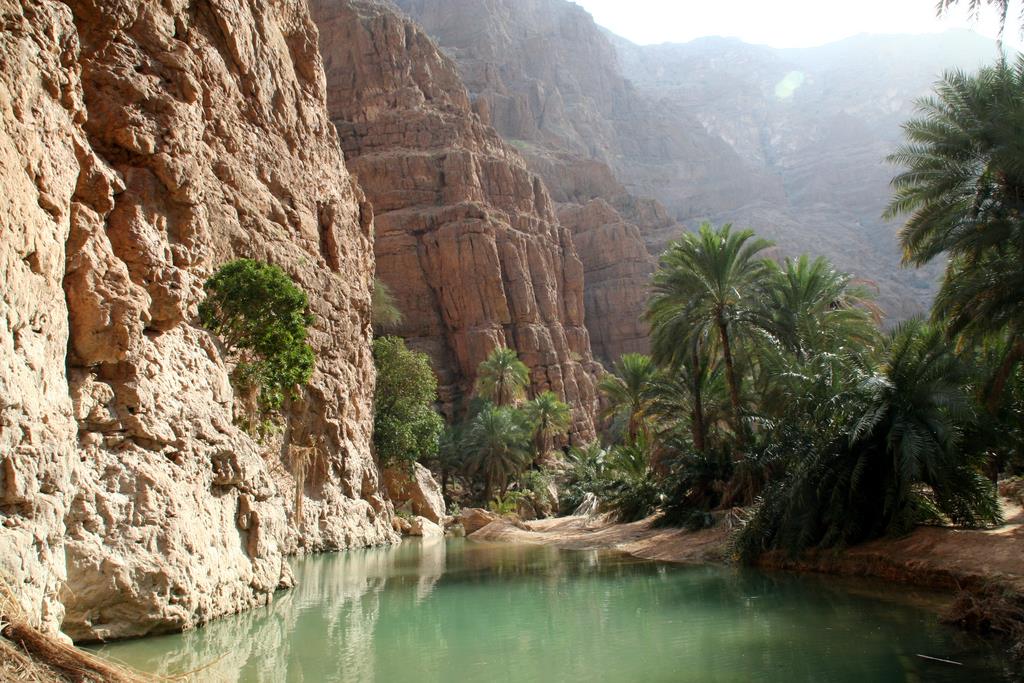
In the psalm, David writes about safe and restful places that God leads him to.  The green pastures and quiet waters sound pretty nice, don't they.  Positively restful.  Like the picture at the top of the post, right?  It appears to be quite an idillic oasis nestled in the midst of natural fortress.  Perfect for a shepherd to rest... right?

But what if it rains?

What you see in the picture is called a wadi.  Basically it translates to "valley," but may be a dry riverbed.  Usually in the desert anywhere with water is prized.  But wadis can be very dangerous due to the very thing that makes them a haven: water.

Two words: flash flood.

"Even though I walk through the valley of the shadow of death,"  (Psalm 23:4a)

If you are standing in the lowest point of a wadi, especially one with steep sides, and it starts raining very heavily, it is not a question of sink or swim.  You won't have time to swim.

The valley David writes about is not a literal one, though I have no doubt he dealt with the dangers of wadis in the rainy season.  No, David's "valley of death" is life.

Our life can be seen as a journey.  There are parts of our journey that looks like the "easy road," so we take it.  It has plenty of cool water and shade and looks like exactly what God wants for us.  Then we look up and see the hills.  They looks a little rocky, and getting to them will be difficult, but we might be able to see where we're going from there.

Beyond the hills, we can see storm clouds.

If we stay in the valley, we could drown.  If we try to climb to reach the hills, we might give up because it's too hard.

We feel trapped.  And maybe we are.  Trapped by our own doing.

"I will fear no evil, for you are with me; your rod and your staff, they comfort me."  (Psalm 23:4b)

"I lift my eyes to the hills - where does my help come from?  My help comes from the Lord, the Maker of heaven and earth."  (Psalm 121:1-2)

In the study, practice, and ministry of faith, there are times we label as "mountain top experiences."  These are the "good times" with God.  The times when His will is clear, or we are in close fellowship with fellow believers.  They are times when our faith is energized and recharged.  Times when we realize that our struggling and toiling on our own was foolish and we should have gone to our Father at the first sign of trouble.

We long for these mountain top moments.  We chase after them sometimes.  But we cannot stay on the mountain.  Peter tried that at the Transfiguration.  But the point was not to stay and "hang out" with Jesus on the mountain.  The disciples had to descend into the valley so that they could find the sheep that have gone astray.

God needs us in the valley, because that is where the work is.  But that doesn't mean that is where we are supposed to stay.  The clear water and green pastures God is leading us to is not in the valley, or even on the ridges and hills we can see.  No, God is leading us to a high plateau far from the valleys.  First seen on this earth as the bedrock threshing floor Solomon built the Temple on, then finalized here as a spiritual plateau we journey to each week in worship.  But even this is a mere rest stop on our journey.  No, the peaceful place the Good Shepherd is leading us to is not on this earth, but our Father's mansion.  Our home: heaven.

While the valleys we travel through are still dangerous and tiring, we can hold our heads high, knowing that while we are not home yet, the Shepherd will see us safely there.

So don't fret about the valleys.  God holds the high ground.

Saturday, February 22, 2014

A Long Time Ago...

I am a major Star Wars fan.  I've seen the original trilogy enough times that I can recite every line, from that first shootout on the blockade runner to the victory celebration on Endor.  I've read many of the Rebellion era books.  In fact, Star Wars is what got me interested in recreational reading and in novel writing.  I was in fifth grade when I started reading Star Wars.  The stories are not only exciting and engaging, but also nostalgic.

So it should be no doubt that I am excited for the upcoming Episode VII.  Or should it?

I have a feeling that unlike some hardcore fans, I am optimistic about this trilogy.  I've read rumors about who will and won't be cast, and what plot elements won't be included.  Wisely, Lucasfilm and everyone involved is being extremely tight lipped.  And because of this, fans have their theories.  Even me.

While I would love to see Thrawn's campaign or the invasion of the Yuuzhan Vong brought to life, I am pretty sure that the Sequel Trilogy will take place after the latest published books.  Why?  Simple.

First, we have to assume one of two things regarding these movies:
1) Lucasfilm is willing to negate almost thirty years of marketing and storytelling to make these films.  They are willing to "kill off" thousands of characters that we have come to know and care about.  They are willing to ignore hundreds of battles, including the end of the war, and the invasion of a new race.  They are willing to deny the development of the major characters from the original Trilogy.
Or…
2) Lucasfilm will be setting this story after the Fate of the Jedi series and will incorporate some of the things from the Expanded Universe novels, but will not make too much mention of them unless absolutely needed.

I believe the second option is the correct one, and for one very undeniable reason.

Coruscant.

In the 1991 novel Heir to the Empire, it was established that the capital planet of the Empire, the New Republic, and the old Republic, was called Coruscant.  This name was allowed, then later elevated to canon status in Episode I.  To completely deny the Expanded Universe will result in the denial of the Prequel Trilogy.

And that's not going to happen.

So, what's going to take place in the "galaxy far, far away?"  Who knows.  The only rumor that seems solid enough to believe is that R2-D2 and C-3PO are to be in all three movies.  This may not mean much at first until you consider the comic series Legacy.  It takes place 130 years after the Death Star was destroyed over Yavin.  R2 is, as usual, working with the Skywalker family.  3PO is nowhere to be seen.  What does this mean?  Maybe that the story's timeline is set between 45-120 years after the events of the first movie.  And that opens up a huge amount of possibilities.

Regardless of what the movies will be about, I am confident that it will be well written, and have great music.

There are rumors that Luke, Han, and Leia will be back, and perhaps for the first movie they will be.  I'm guessing we'll get to see the reestablishment of the Empire, under the leadership of a former hotshot starfighter pilot named Fel.  And with it the founding of the Imperial Knights.  Perhaps under the command of the oldest Solo child.

Anyway, this is all personal speculation.  Except the theory on Coruscant being proof the EU is not being discarded.  Logically, that's more than just plausible.

Though it is fun to theorize who will play which character.  I saw today that Dwayne Johnson want's to be in the movies.  My first thought was "I could see him being Talon Karrde, if he had more hair."  Then I thought, "Maybe some of the Wraith alumni, like Face or Piggy."  Picture the Rock with a scar and goatee, then compare that to the cover of Enemy Lines II: Rebel Stand.

Okay.  I've gotten that out of my system now.  Its a nice day here, so I think the kiddos should go and run around outside.

May the Force be with you.

Thursday, January 16, 2014

Dawn

Its funny where we find inspiration.  Most of the time, while writing, I find it in music.  I've got a number of stories I'm working on, and each as a "playlist."  While working on one, and listening to the background soundtrack, I got this mental image of the sun rising over a rocky ridge.  In the valley was a garden.  Well… perhaps you should read it.  If you want, listen to the song while you do.

Dawn

Adam Baumann
28 August 2013
(composed while listening to “Victory of Life” from Future World Music)


Dawn cascades over the Kidron’s ridge,
Preceding the sun’s daily arcing journey towards night.
The light bathes the valley in shadows
Before finally breaking over the face of the mountain.
In the valley beneath,
Two silent fishers dart,
Rushing through the last pools of shadow,
Expecting to find what they know to be there.
Hoping to find that nothing awaits them.
The first stops short,
Unable to continue past the stony barricade.
The other more boldly continues.
He stoops to see if the sight matches the words
That inspired an impossible hope in his very soul.
The bed lay bare just as they said,
Without a single shred of evidence
That the three-day-old ghost had ever been there.
Bewildered the fishers turn to leave,
Sure of nothing but the empty evidence.

Now dawn creeps up the walls of the House,
Glinting of the very pillars of faith
Where faith spoke aloud for all to hear.
But in the shadow of the sun
A simple sound is heard.
One of the messengers the fishers followed
Remains near the room
Where no one resides.
Distraught she loiters without purpose,
Except to add to the morning’s dew.
One of the few to have seen the pain
That was put to rest in that room,
Her tears speak not of hope but of despair,
For it is clear that someone had stolen
The once living hope:
The only son worthy of calling the dawn,
Who was laid low and cold
In a manger of rock and dust.
In the only room left.

As the dawn climbed higher
To light on the rooftops
Of the city that passed the sentence,
She stood without a sound
Except for the silent sobs
Of a broken heart and hope.
They were sure that they had found it:
The incredible promise of rescue
Given to their parents
Long ago in a lost paradise.
They had watched as the incredible happened
More times than could be numbered.
Nothing had stood in their way,
Not darkness nor storms nor illness.
They had been brave soldiers
Until that night when the light was captured,
And they scattered like glass
Shattering on stone.
Too afraid to believe in hope anymore.

The dawn finally breaks
As the golden orb make a final leap above the mountain.
But in the valley the shadow remains
Awaiting vanquish,
Though it does not wait long.
Abandoned by the fishers,
She collapses in anguish
Only to find a most unexpected comfort:
A pair of worn and scared feet.
Slowly but surely the shadows depart
Allowing light to ripple out
And envelop the garden.
The dawn embraces her
And invigorates her,
Like the breaking of a fever.
Unable to move she stares
At unshod feet so familiar
Yet so foreign with their piercings.
Finally she looks up,

To see dawn’s gentle reflection in the smile of Jesus.

Tuesday, January 14, 2014

To Put Pen To Page

Just a little free-verse poem I wrote on writing.  Enjoy.


To Put Pen To Page

The blank sheet glares up at me
as if challenging me to put pen to page,
daring me to violate its pure white face.
To expose my thought and feelings upon it.
To build a world made of words.
A world where the greatest fantasy
or coldest dread can come to life.
A grand journey can begin 
with a simple stroke of a pen.
In my mind swirl images:
of a thousand warriors on horseback
charging down a hillside;
of a lone pilot,
deftly weaving his vessel
through debris and enemies;
Of a couple’s final kiss shared on bridge
before taking the last step in a journey together;
Of a solitary figure standing guard over a white marble tomb
where true honor rests;
Of a new father holding his child for the first time 
and realizing that this is his ultimate task.
It is that emotion that I feel 
moments before the first time the pen presses into the paper.
The knowledge that I am stepping out of my world 
and into another. 
A world where my thoughts, 
hopes, 
fears, 
and dreams, 
can become a reality.
And all I must do, 
to take the first step 
of my epic journey, 
is to put pen to page.